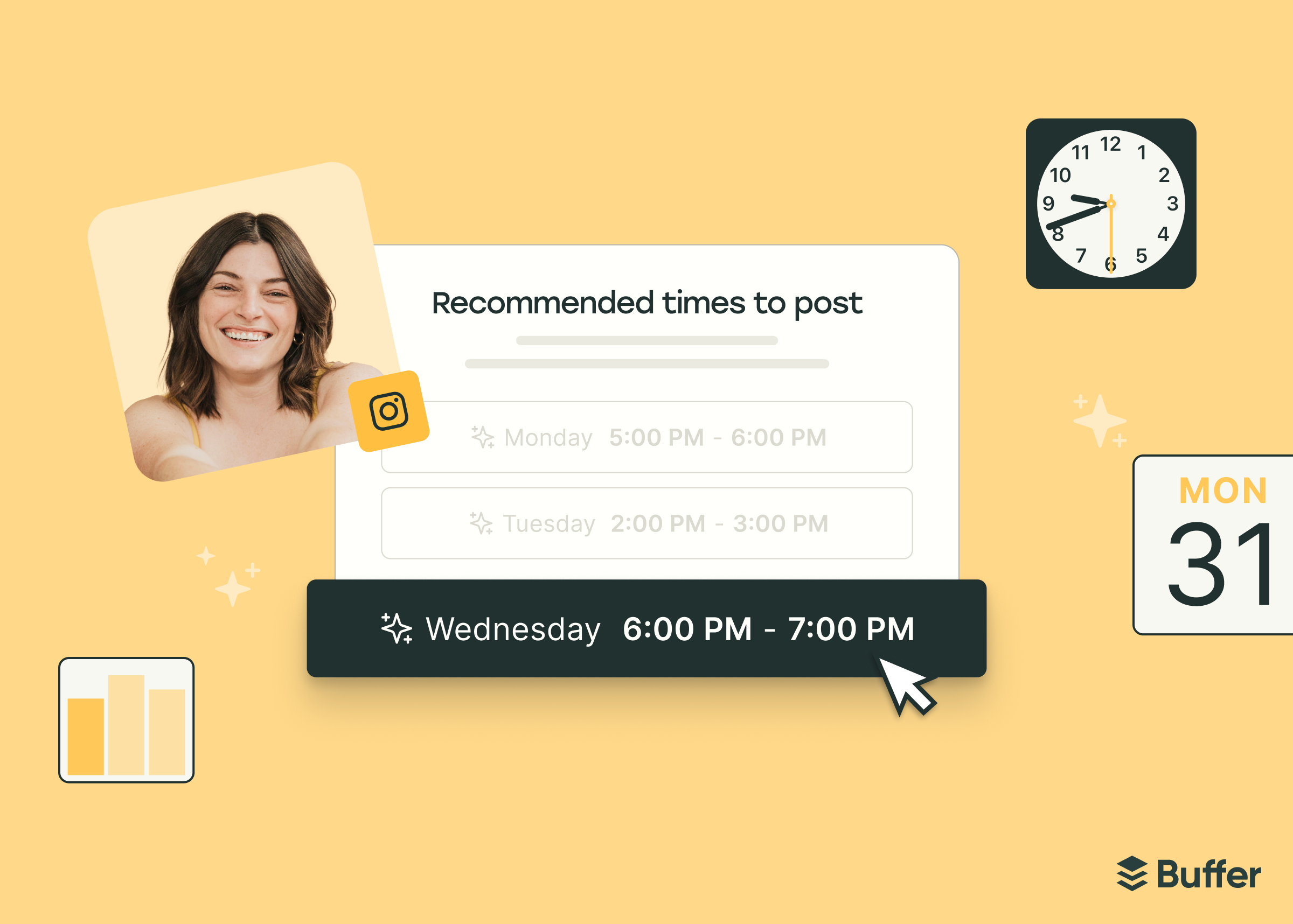
Most social media tools — including Buffer, historically — operate on a pretty simple model: you give us your content, we publish it, we show you some charts. If you want to improve, that's on you. Go look at the analytics. Figure out what's working. Adjust your strategy. Come back and use the tool again.
The problem is the gap between the data and what you're supposed to do with it. It’s where most people get stuck.
Take posting times as an example. It's one of the most common questions we hear: "When should I post?" And the honest answer has always been: "It depends. Look at your analytics. Test different times. See what works for your audience."
Which is technically correct but also exhausting. Especially if you're managing multiple accounts, or you're a creator juggling social alongside everything else you do, or you're just trying to stay consistent without turning it into a part-time job.
So we've been asking ourselves: why are we making people do this work? We have the data and we can see patterns in their performance.
We're kicking off an effort to build a more insights-driven product—one that actively helps you make better decisions about your social media presence. And we're starting with something fundamental: when to post.
Introducing Smart Scheduling
We've recently introduced an algorithm-based approach that automatically determines optimal posting times based on what we know performs well for each platform. We’re calling it Smart Scheduling.
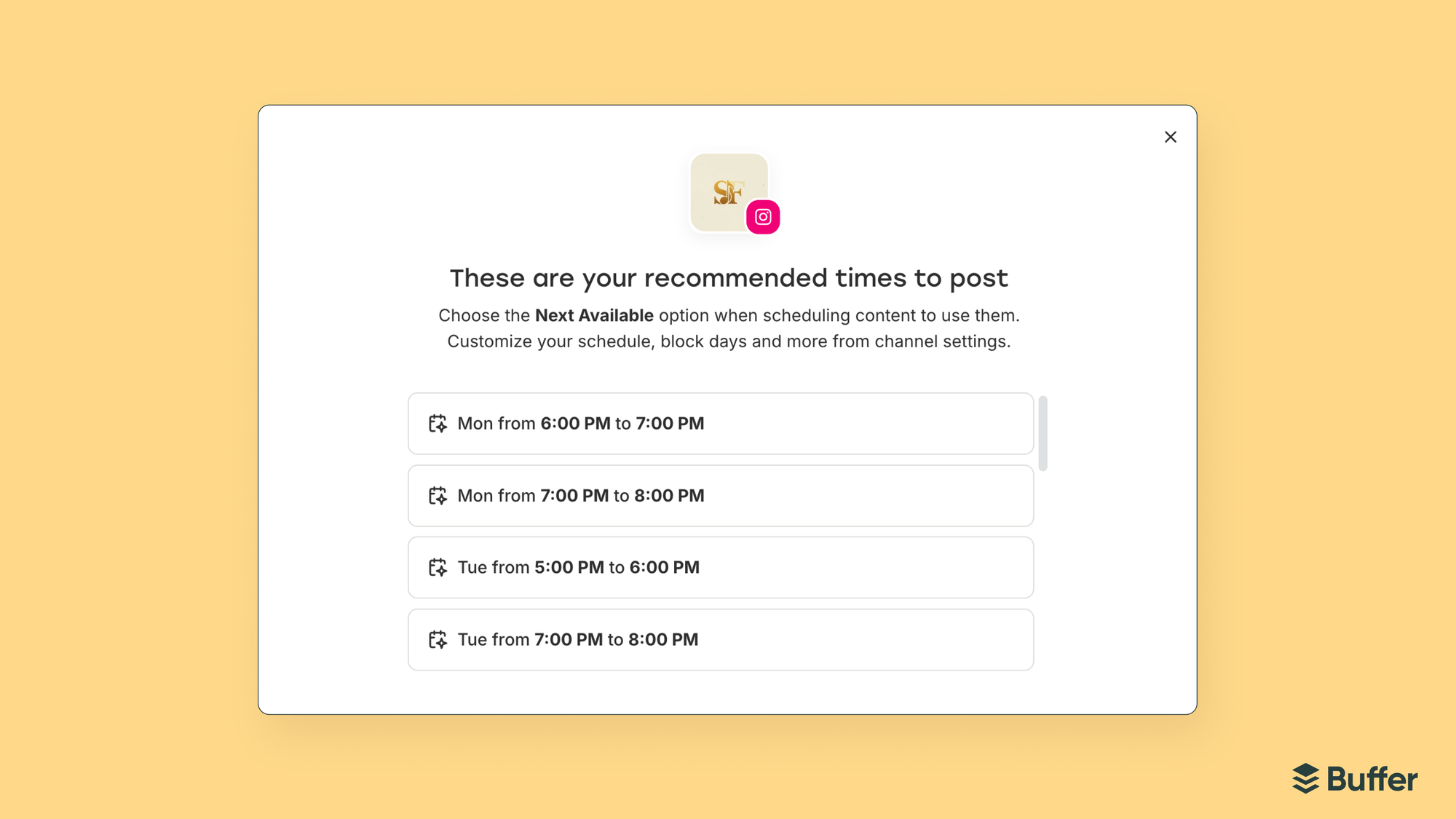
When you're setting up a posting schedule, Buffer will now suggest times based on proven patterns across each network. You can accept the recommendations and let Buffer handle the timing, or customize your schedule if you prefer specific control. If you’re new to Buffer, this removes the guesswork and gets you posting at times that are likely to work.
If you already have a posting schedule running, you can update it to use recommended times with a single click. We'll show you what's changing before you confirm, and if you have posts already queued, we'll let you know they'll shift to match your new schedule.
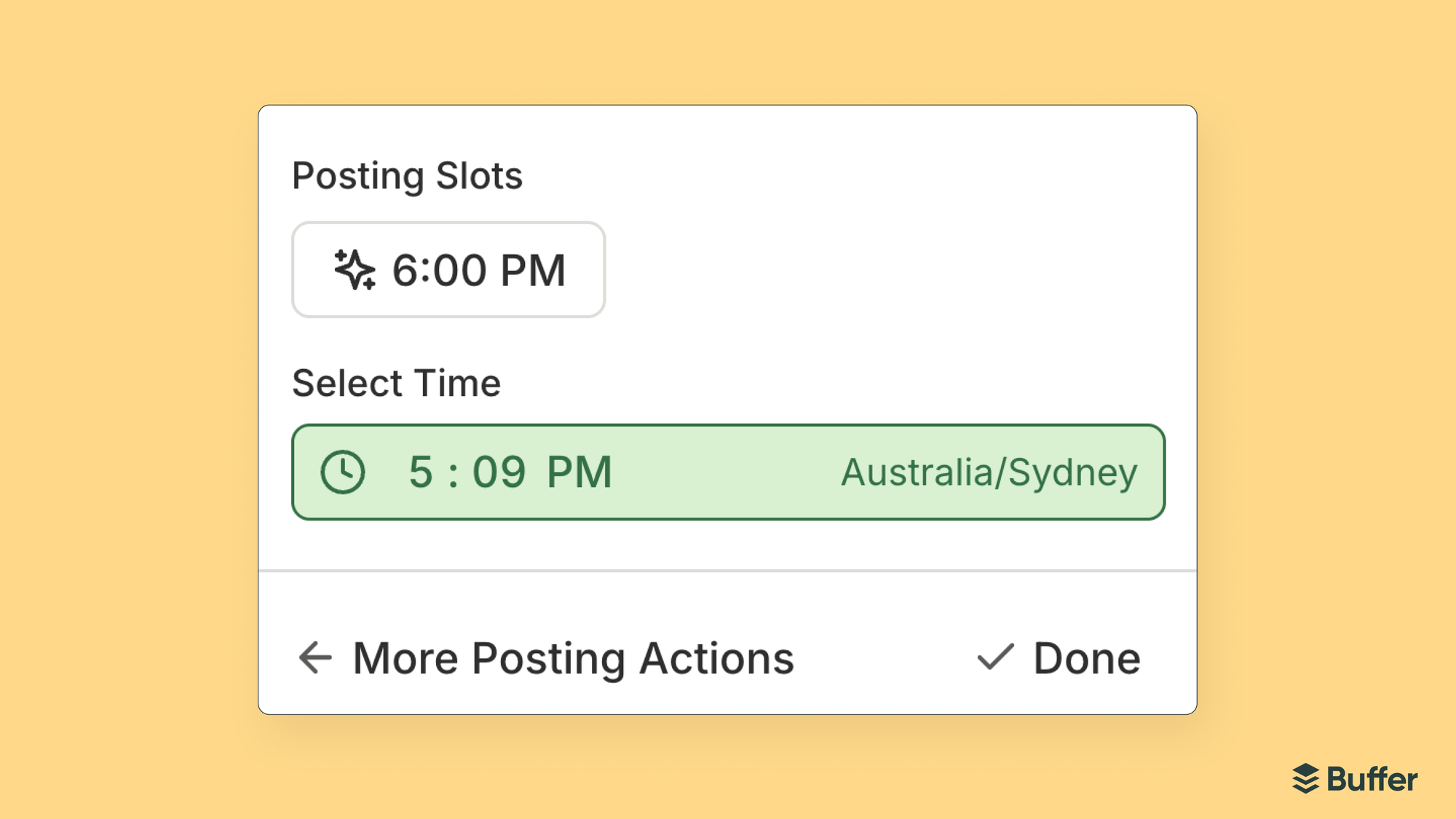
We’ve also added posting time recommendations for specific days. Let’s say you have a post that must be published on Friday, but it’s not part of your typical posting schedule, and you want it to land at the optimal time. Rather than you needing to pick a random time, we’ll recommend a best time for that day.
These are small shifts in how the product works, but it reflects a bigger change in how we're thinking about Buffer's role for creators, marketers and small businesses.
More to come
Instead of just being a place where you schedule posts and check stats, Buffer will actively help you get better at social media. It will surface the right insight at the right moment, as a natural part of your workflow.
This is the direction we’re headed:
More contextual recommendations. If your engagement is trending down on a channel, we will tell you and suggest what might help. If your best-performing content type has shifted, we will flag it before you spend another week posting the wrong thing.
Metrics that are useful AND comprehensive. We're going to make key insights accessible to everyone, not just users on paid plans. And we're going to focus on the metrics that actually help you make decisions, not just the ones that look impressive in a report.
Automation that makes you faster without making you generic. For people who rely on social media professionally, this means tools that handle the repetitive stuff like optimizing posting times, or identifying your best content to reshare, so you can focus on the creative and strategic work only you can do.
The common thread: your social data should work for you. Not the other way around.
We think there is a real opportunity to:
- Help you stay consistent without the cognitive overhead of constantly second-guessing your strategy.
- Give you the flexibility to work however you want—one account or twenty, free plan or paid—while still getting the insights you need to improve
That's the Buffer we're building toward: one that makes all your social data useful and actionable to you, so you can focus on your voice and your business. More to come!
from Buffer Resources https://ift.tt/Vgv7pRX
Most social media tools — including Buffer, historically — operate on a pretty simple model: you give us your content, we publish it, we show you some charts. If you want to improve, that's on you. Go look at the analytics. Figure out what's working. Adjust your strategy. Come back and use the tool again.
The problem is the gap between the data and what you're supposed to do with it. It’s where most people get stuck.
Take posting times as an example. It's one of the most common questions we hear: "When should I post?" And the honest answer has always been: "It depends. Look at your analytics. Test different times. See what works for your audience."
Which is technically correct but also exhausting. Especially if you're managing multiple accounts, or you're a creator juggling social alongside everything else you do, or you're just trying to stay consistent without turning it into a part-time job.
So we've been asking ourselves: why are we making people do this work? We have the data and we can see patterns in their performance.
We're kicking off an effort to build a more insights-driven product—one that actively helps you make better decisions about your social media presence. And we're starting with something fundamental: when to post.
Introducing Smart Scheduling
We've recently introduced an algorithm-based approach that automatically determines optimal posting times based on what we know performs well for each platform. We’re calling it Smart Scheduling.
When you're setting up a posting schedule, Buffer will now suggest times based on proven patterns across each network. You can accept the recommendations and let Buffer handle the timing, or customize your schedule if you prefer specific control. If you’re new to Buffer, this removes the guesswork and gets you posting at times that are likely to work.
If you already have a posting schedule running, you can update it to use recommended times with a single click. We'll show you what's changing before you confirm, and if you have posts already queued, we'll let you know they'll shift to match your new schedule.
We’ve also added posting time recommendations for specific days. Let’s say you have a post that must be published on Friday, but it’s not part of your typical posting schedule, and you want it to land at the optimal time. Rather than you needing to pick a random time, we’ll recommend a best time for that day.
These are small shifts in how the product works, but it reflects a bigger change in how we're thinking about Buffer's role for creators, marketers and small businesses.
More to come
Instead of just being a place where you schedule posts and check stats, Buffer will actively help you get better at social media. It will surface the right insight at the right moment, as a natural part of your workflow.
This is the direction we’re headed:
More contextual recommendations. If your engagement is trending down on a channel, we will tell you and suggest what might help. If your best-performing content type has shifted, we will flag it before you spend another week posting the wrong thing.
Metrics that are useful AND comprehensive. We're going to make key insights accessible to everyone, not just users on paid plans. And we're going to focus on the metrics that actually help you make decisions, not just the ones that look impressive in a report.
Automation that makes you faster without making you generic. For people who rely on social media professionally, this means tools that handle the repetitive stuff like optimizing posting times, or identifying your best content to reshare, so you can focus on the creative and strategic work only you can do.
The common thread: your social data should work for you. Not the other way around.
We think there is a real opportunity to:
- Help you stay consistent without the cognitive overhead of constantly second-guessing your strategy.
- Give you the flexibility to work however you want—one account or twenty, free plan or paid—while still getting the insights you need to improve
That's the Buffer we're building toward: one that makes all your social data useful and actionable to you, so you can focus on your voice and your business. More to come!
Comments
Post a Comment