
I currently author Buffer’s Substack, The Weekly Scroll, which has grown to 92K+ subscribers, and I’ve spent the past month publishing to Notes every day. That hands-on, day-to-day experience is why I revisited and reworked this guide.
Ever since we moved The Weekly Scroll, Buffer’s newsletter, over to Substack a few months ago, I’ve been learning the platform from the inside rather than writing about it as an outsider. A lot of the advice and learnings from my first pass at this guide held up, but some of it didn’t, especially since Substack has changed a fair bit since then.
So this reworked guide walks through everything from setting up your account to growing and monetizing your newsletter, with advice from the creators I interviewed and everything I’ve learned firsthand.
Let’s get into it.
Key takeaways
- Substack is a free newsletter platform with a social layer built in. You publish posts that go out by email, and Notes, Chat, and Live sit around them for discovery and community.
- Subscribers and followers are different groups. Subscribers get your emails; followers only see your Notes in the app. You want both, but subscribers are the ones who'll read your newsletter.
- Setting up properly takes about an hour: fill in your profile, set up the publication and its categories, rewrite the welcome email, connect Stripe, import any list you have, and publish a welcome post and a first Note before you start the regular issues.
- Pick a niche you can describe in a sentence and a schedule you can stick to. Fill in the SEO title and description on every post while you're at it, because Substack articles do rank on Google.
- Most growth happens inside Substack, through Recommendations and Notes, so switch those on before you spend time sharing links elsewhere.
- Substack is free until you turn on paid subscriptions, at which point it takes 10% plus Stripe's processing fees.
Jump to a section:
What is Substack (and how does it work)?
Substack is a publishing platform where you write posts and send them to subscribers by email, for free, with the option to charge for some or all of your work.
The platform is part social network and part newsletter tool, as every publisher gets a website, an archive, and a profile in the Substack app, where readers can find you through recommendations and the Notes feed.
The simplest way I've found to explain how it all fits together is in three parts: the content you publish, the audience that finds and follows it, and the money you can (but don't have to) make from it.
Content
There are four content surfaces you can use in Substack.
Posts
Posts are the main draw on the platform. They go to your subscribers' inboxes and live on your publication page, and they can be long-form writing, audio, video, or a mix of all three.
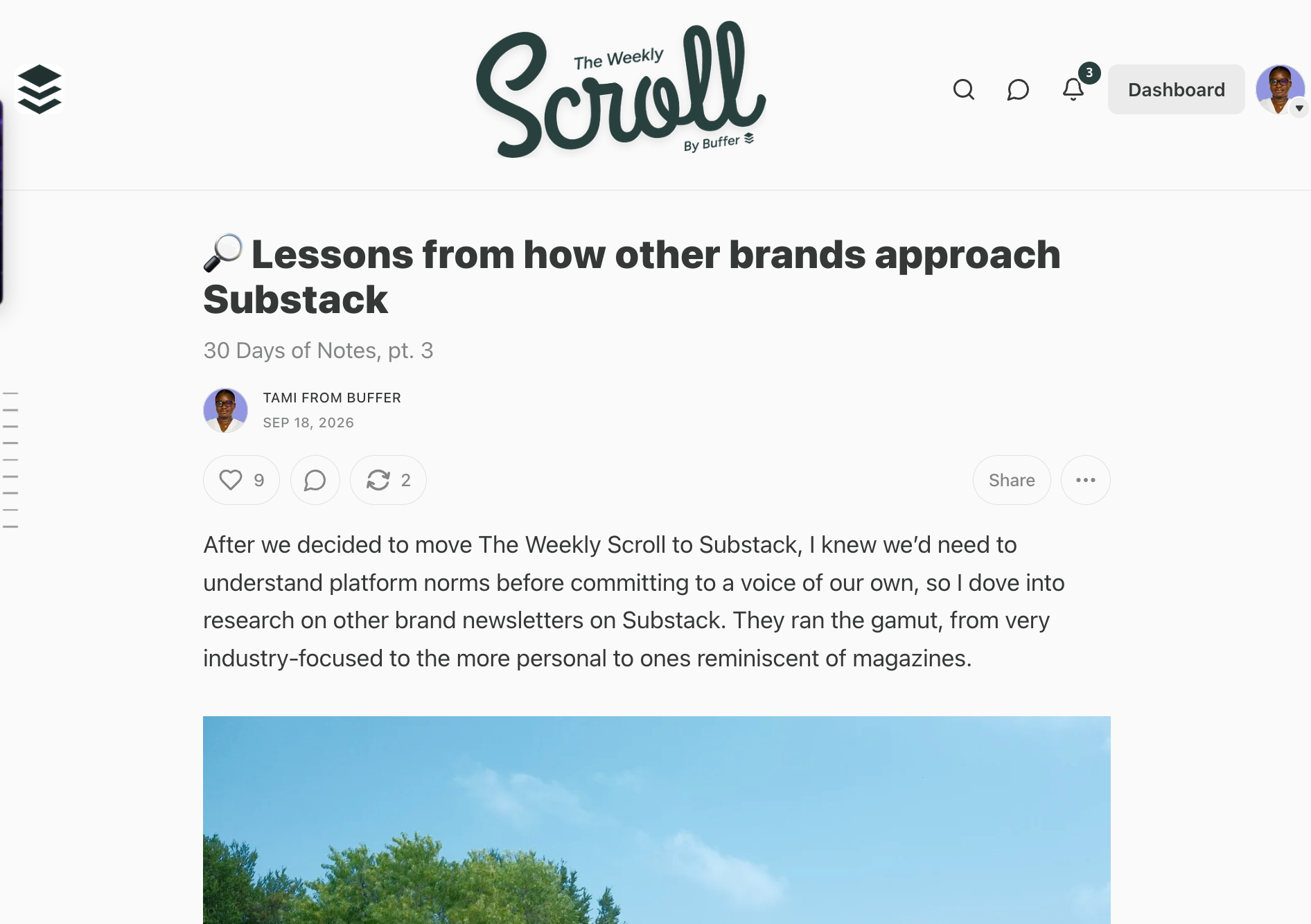
Substack’s audio and video capabilities have evolved a lot. You can run a podcast from Substack and it gives you an RSS feed you can submit to Apple Podcasts, Spotify, and the rest.
You can also publish video posts by uploading a file or recording directly in Substack's Recording Studio (which will look familiar if you’ve ever used Riverside).
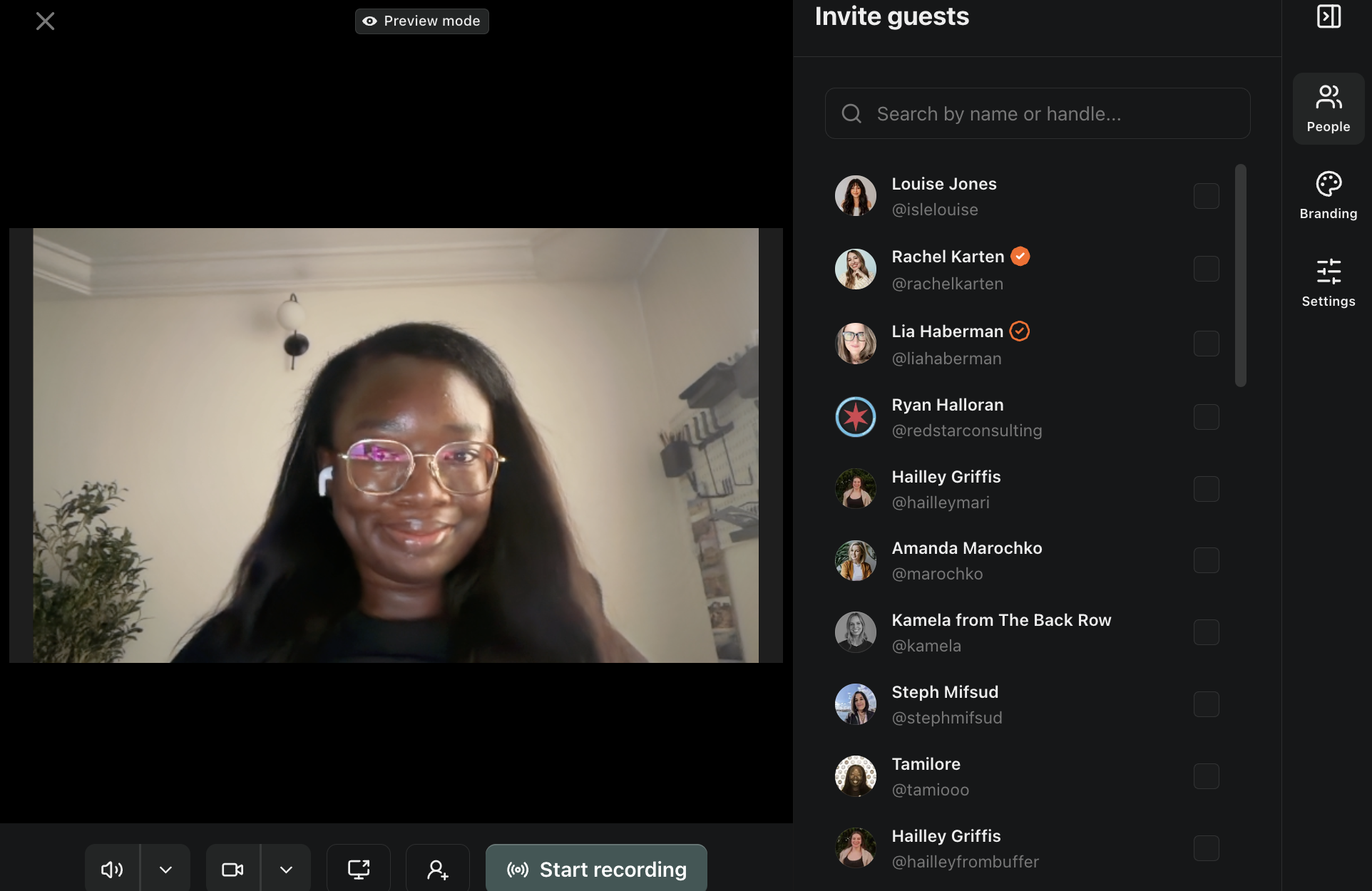
Every audio or video post gets a transcript, which you can edit or switch off. And if you connect your YouTube channel under Settings → Connected accounts, Substack will upload your video posts to YouTube when you publish them, along with up to two auto-generated clips as Shorts.
Notes
Notes is Substack's short-form content feed, which works a lot like X or Threads. Anyone on Substack can post Notes, whether or not they have a publication, and they're public, so people who don't follow you can still come across them.
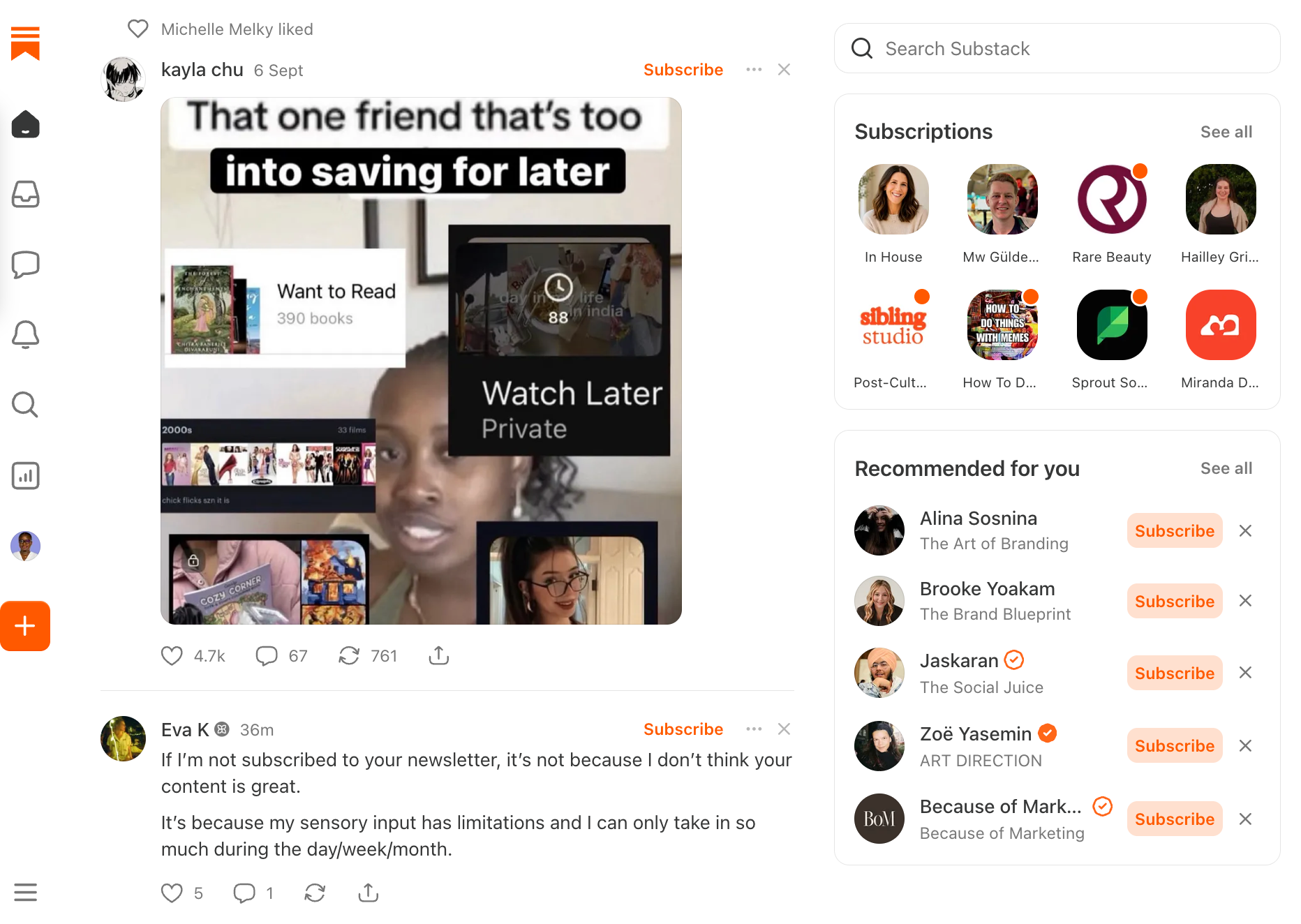
A Note can be plain text, text with up to six images or GIFs, or a video up to five minutes long. There's also a restack button on every post and Note, which reposts it to your own feed with or without your added commentary. Video Notes and clips from your video posts also show up in the app's media tab, which is Substack's vertical, short-form video feed (it launched in early 2025 and works roughly like the TikTok or reels feed, but only for Substack content).
Chat
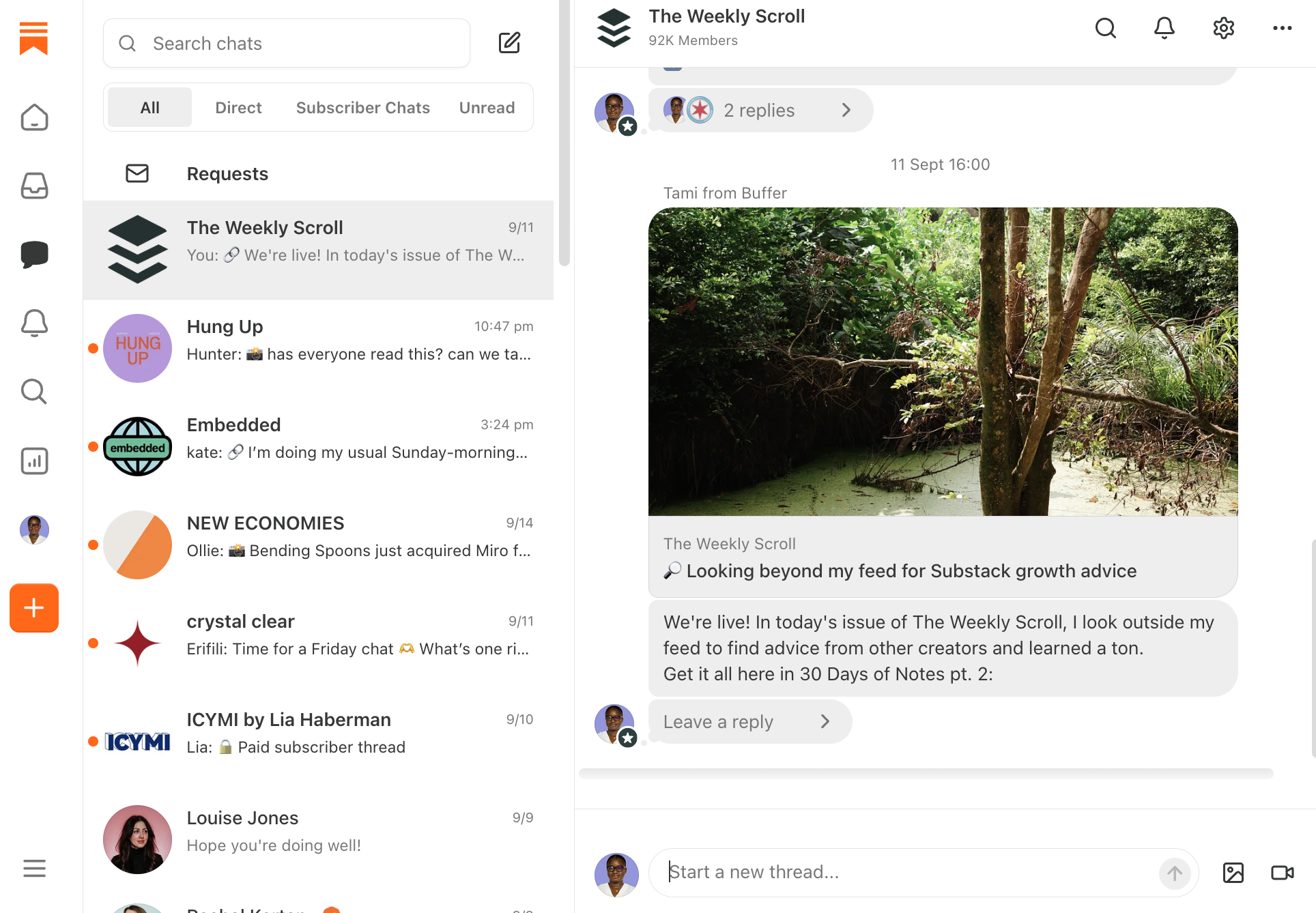
Chat is a space for conversations with your subscribers, and it only exists inside the app and on your publication page, not by email. Only your subscribers can see it. By default you start the threads, but you can let subscribers start them too, and threads can hold text, photos, image replies, and emoji reactions, so it works a bit like a group chat you host. Substack's direct messages live in the same tab, so this is also where one-to-one conversations with readers and other writers happen.
Live
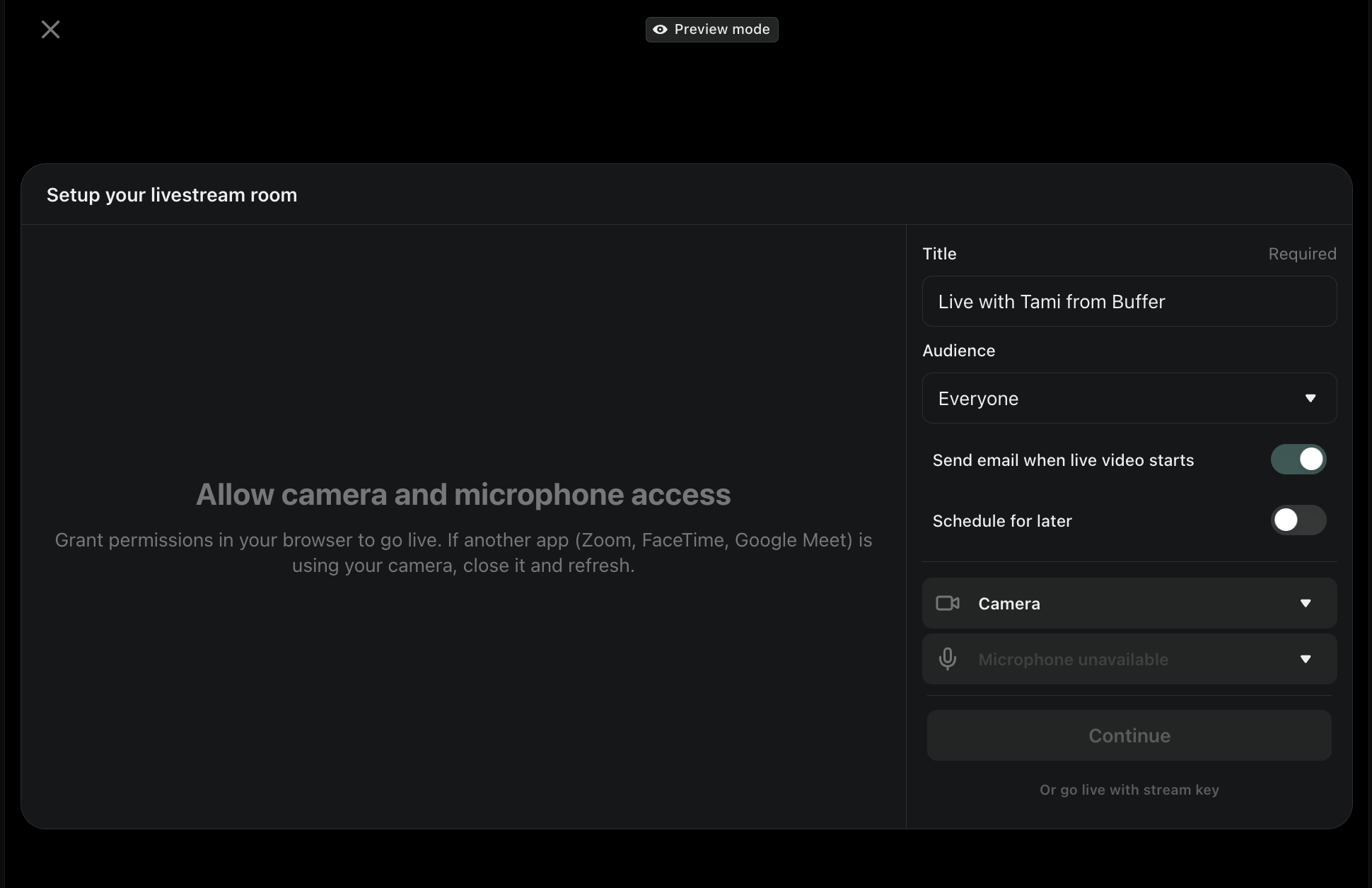
Live lets you stream video to your audience from the Substack app or your computer. You pick who can watch (everyone on Substack, all your subscribers, or paid subscribers only), you can invite up to two other Substack writers to stream with you, and you can schedule a live in advance. When you go live, Substack notifies your subscribers and adds the stream to their queue.
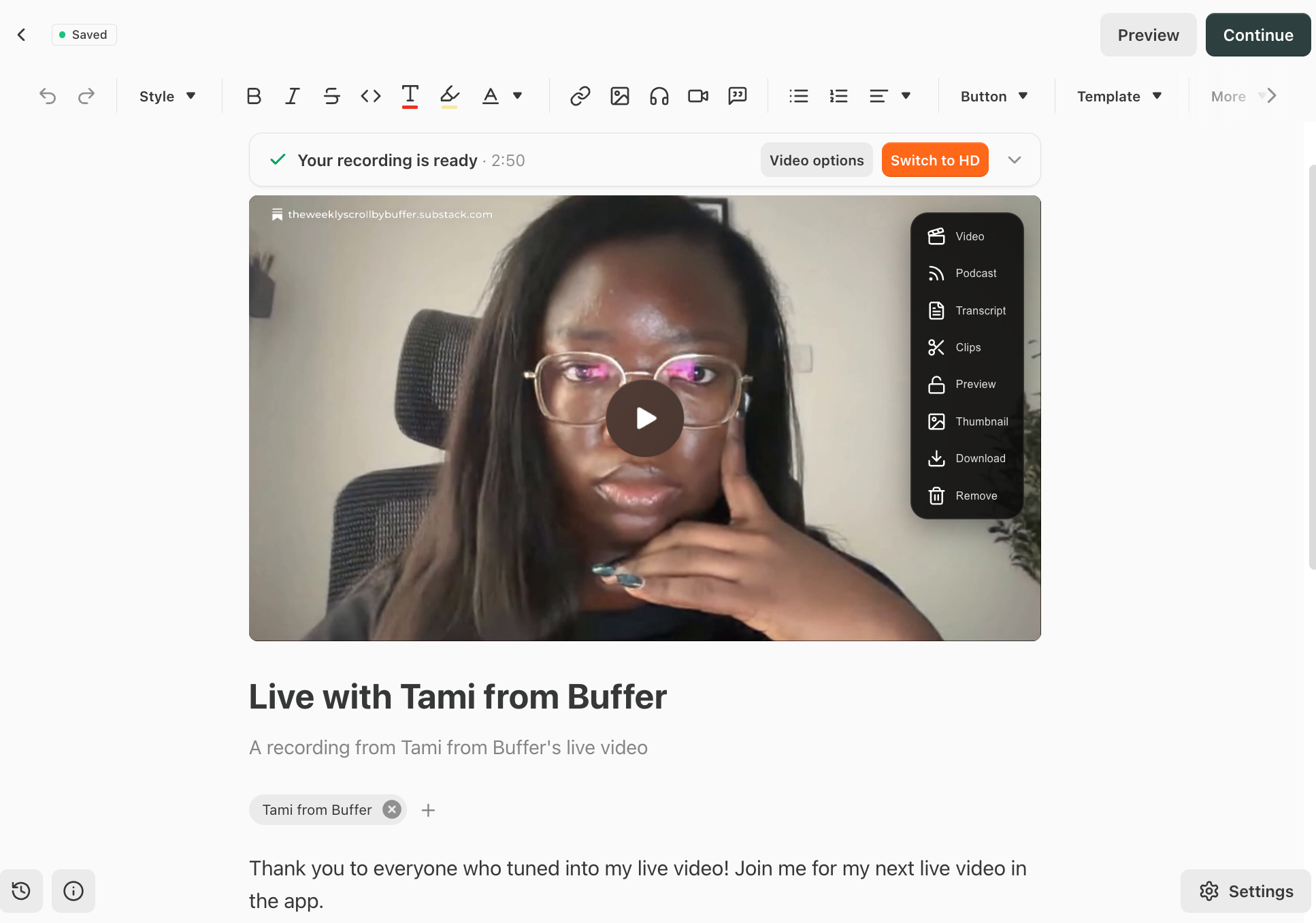
Once you finish, the recording is saved as a draft post, so you can edit it and send it to the subscribers who didn't catch it live, or cut clips from it to share as Notes. If you already stream with something like OBS or Riverside, Substack supports RTMP, so you can send that feed in rather than using the app's camera.
Audience
On Substack, subscribers and followers are not the same thing (which definitely confused me a bit at first!).
- Subscribing: When someone subscribes to your publication, they get your posts by email as well as all your other content.
- Following: When someone follows you, they only see your Notes and activity in their app feed, but they don't get any emails. Followers exist because Notes exist, so they're more like a social following than a newsletter audience.
This distinction is important because Substack shows you Notes from writers you don't follow and shows your Notes to people who don’t yet follow you. This way, your Notes can reach people who've never heard of you.
And of course, the goal with followers is to eventually turn them into subscribers, since you control and can export your subscriber list anytime and take it to another platform, but you can't export your followers.
Monetization
Substack is free for you and free for your readers unless you turn on paid subscriptions. When you do, you connect Stripe (an external payment platform), set your prices (monthly, annual, and an optional founding tier for readers who want to pay more), and choose what sits behind the paywall. That can be whole posts, part of a post with a free preview, paid-only Chat threads, or paid-only lives.
Substack takes 10% of that revenue, and Stripe takes its processing fees on top. I've broken the actual numbers down in the monetization section, along with when to start charging and what the creators I spoke to and researched put behind their paywalls.
How to use Substack: setting up your publication step by step
While you can technically publish your first Substack post within about five minutes of signing up, I'd hold off. Spending an hour on setup first means that when someone lands on your page from a Note or a recommendation, they see a real publication, not a blank profile with one post. Here's the order I'd do it in.
1. Create your account and fill in your profile
Head to substack.com, sign up, and go straight to Edit profile (click your profile picture, or go to substack.com/profile/edit) before you do anything else. Your profile is what shows up when someone taps your name in Notes, and it's the first thing a potential subscriber checks.
- Add a photo — we went with a face (mine), but a logo works too.
- This is also where you set your handle, which becomes your profile URL and what people use to tag you.
- Create a short bio, and add links to your other socials. The bio should say what you write about and who it's for, in the way you'd say it to someone. So instead of "I'm a marketing expert sharing my thoughts on digital trends," something like "Every week, I break down digital marketing trends into strategies you can actually use."
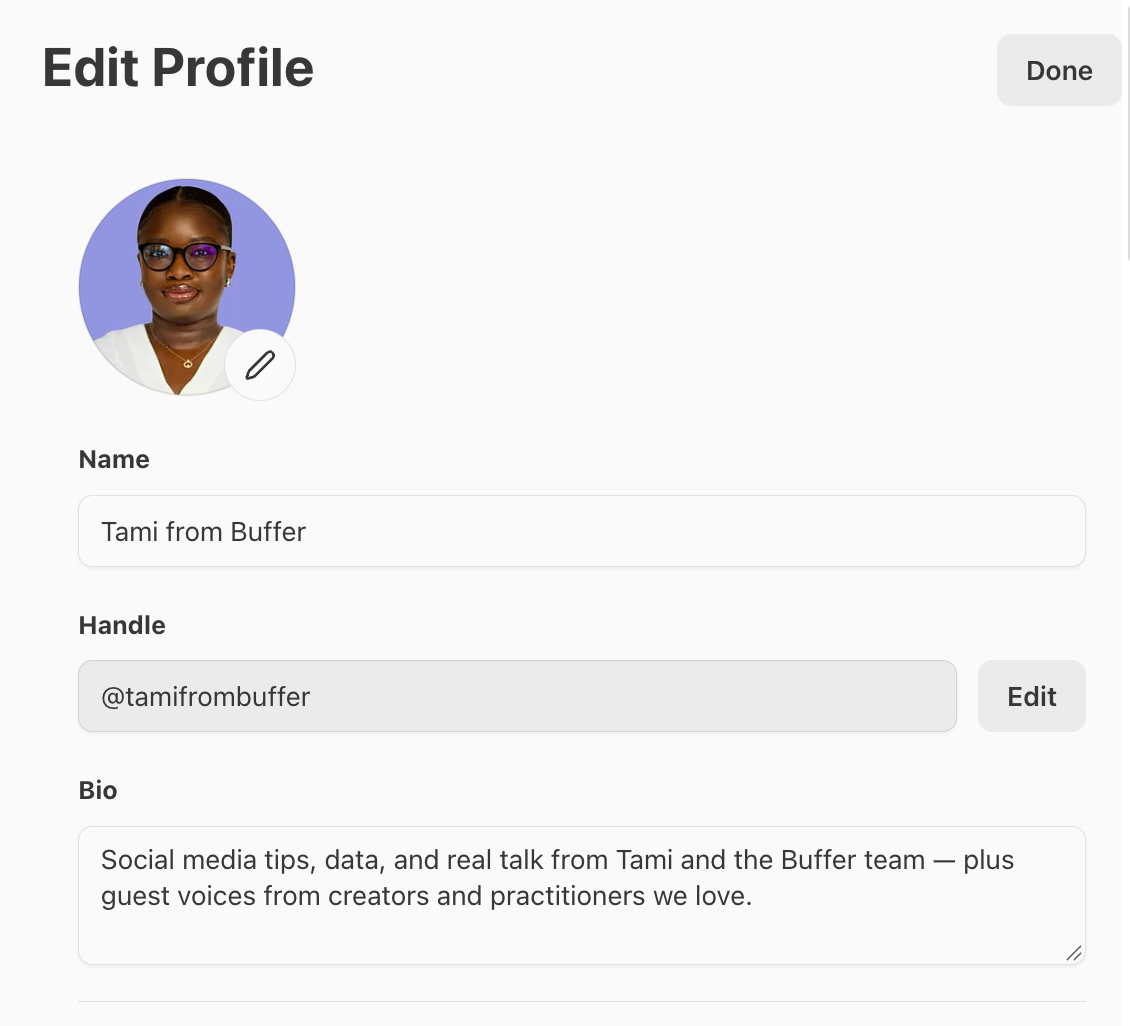
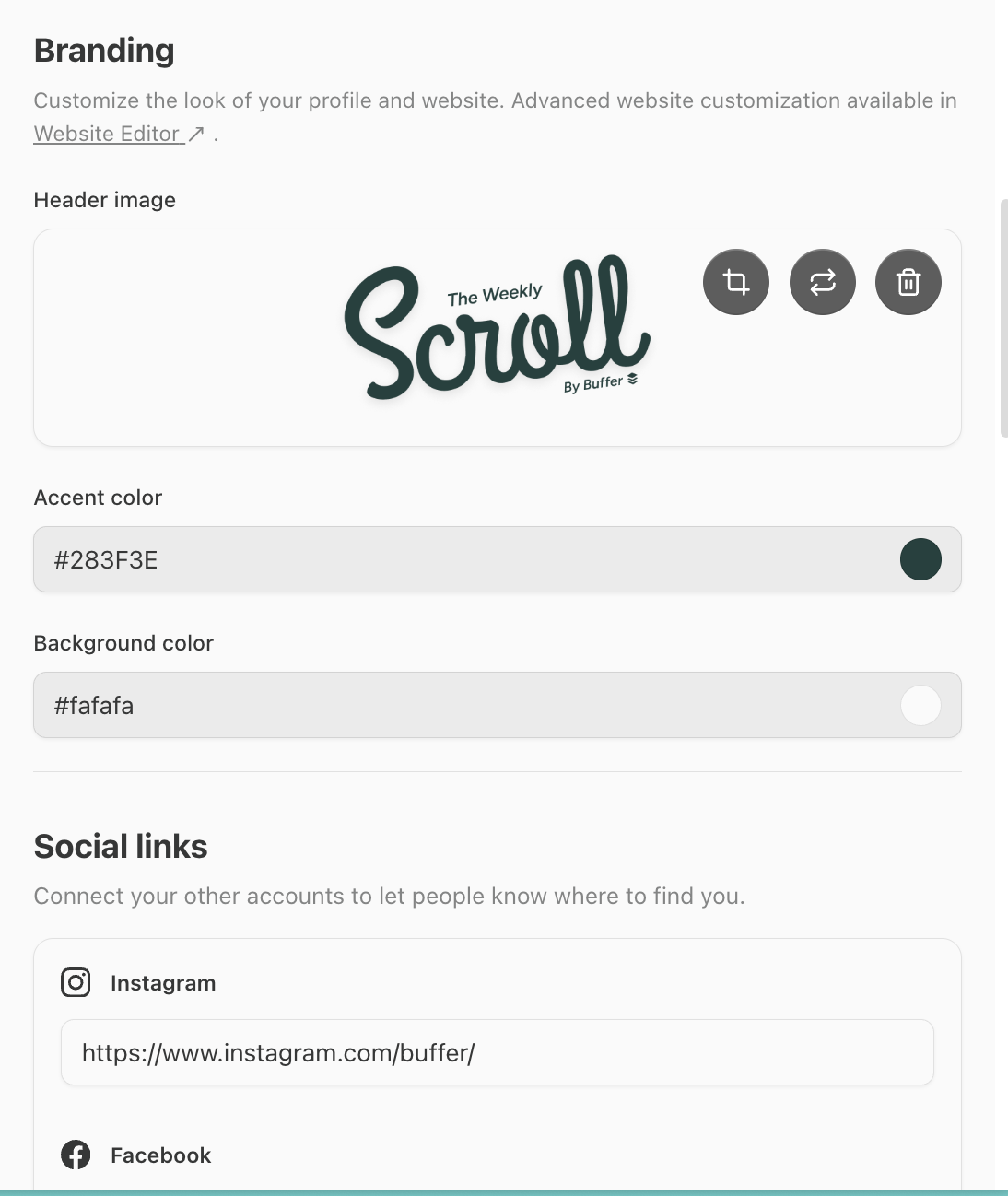
There's also a Branding section on the same page where you can add a header image and pick an accent color for your profile. It's optional, but it’ll only take a minute and makes the page look polished and personalized.
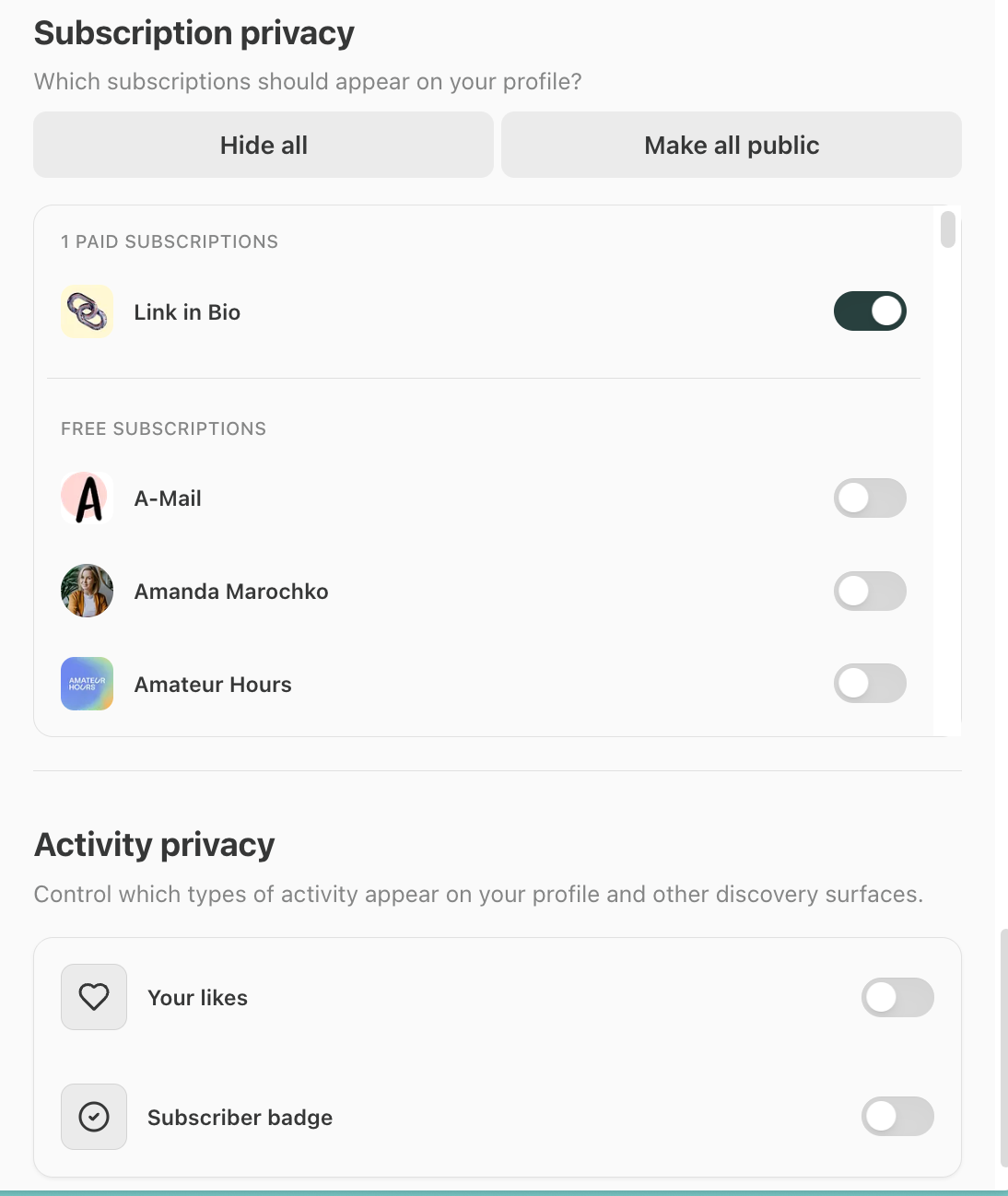
⚡Under Subscription Privacy, you can choose whether the publications you subscribe to show on your profile. I like to have this visible, along with the specific publications we love here at Buffer, because it helps amplify similar newsletters (recommendations are a big deal on Substack) and what you read says a lot about what you write.
2. Set up your publication
A profile lets you post Notes and follow people, but a publication is the actual newsletter, with its own name, URL, subscribe page, and settings.
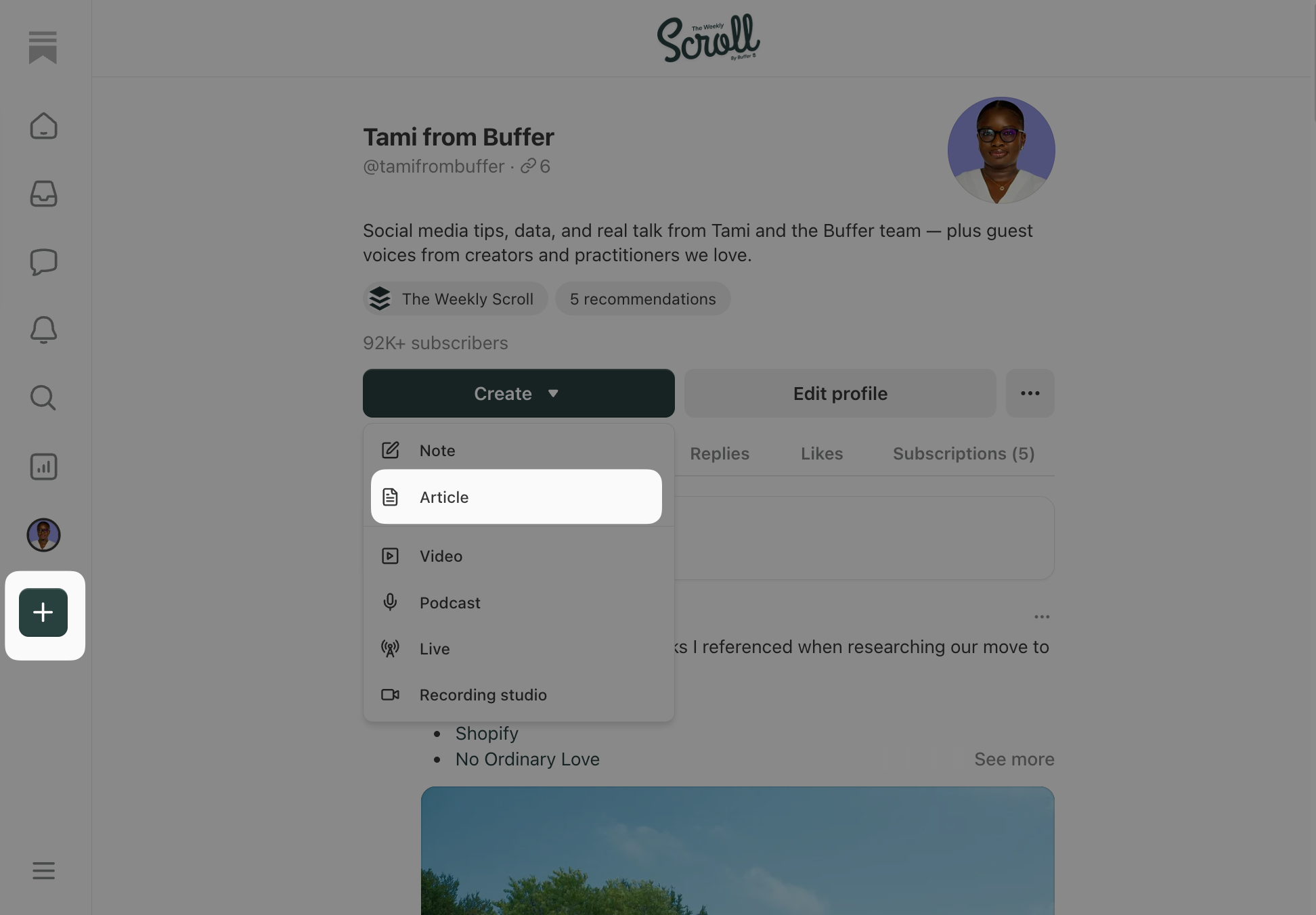
Substack creates one for you automatically, and the first time you click the + button on your Home page or Create in your profile page and choose Article, you'll land on it.
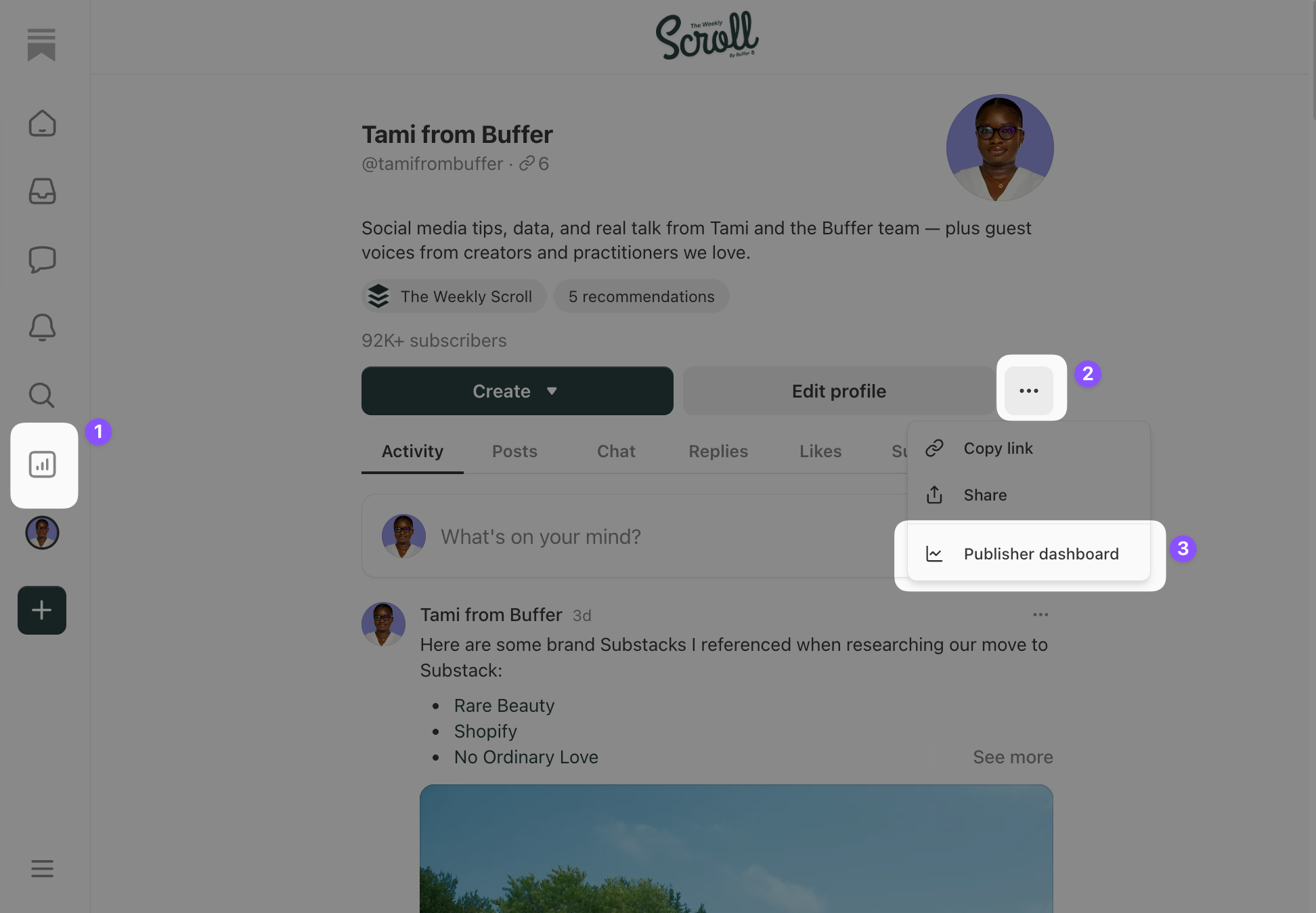
To make modifications to the publication, you’ll want to get to your Publisher dashboard, which you can access by selecting the graph icon on the left to take you straight there, or clicking the three dots on your profile, then selecting Publisher dashboard.
At the bottom left, you’ll see Settings, where you can modify all the details about your publication, from your name to payments.
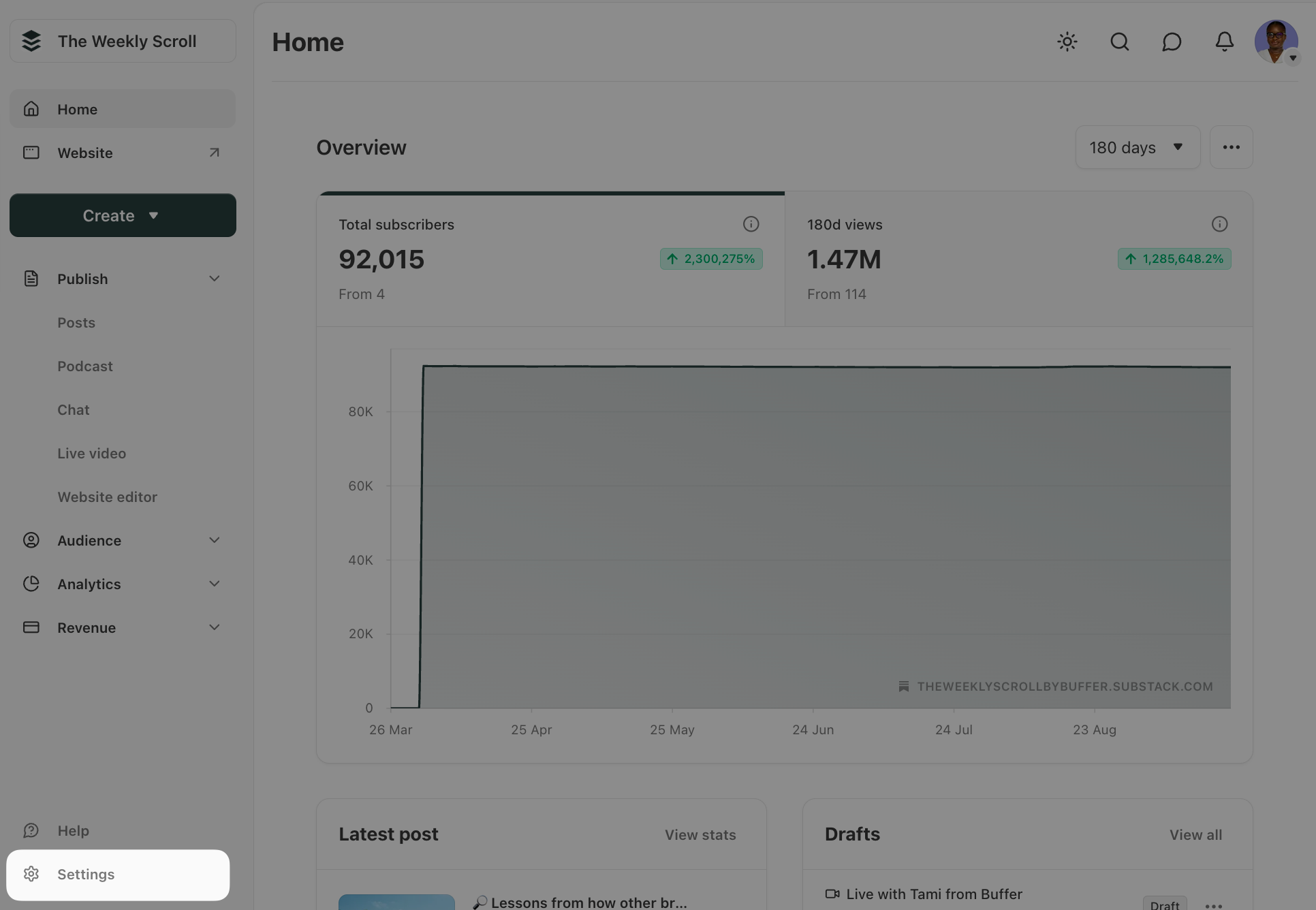
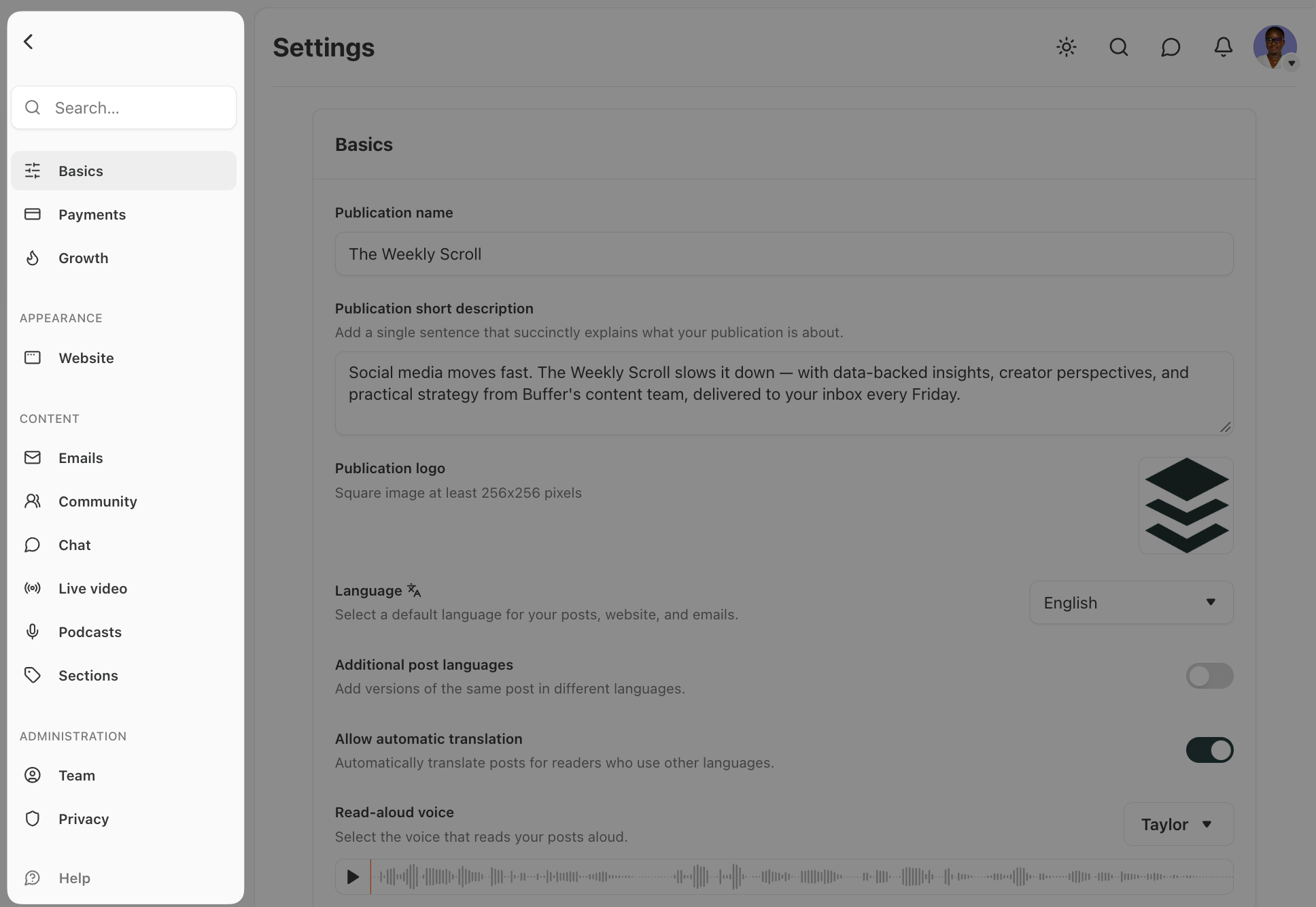
Some immediate things to do in your Settings:
- Pick a name and your URL. You can change both later, but that may confuse subscribers, and you can't set up a redirect (to my knowledge), so choose wisely. If you'd rather use your own domain, that's under Settings → Domain. It's a one-time $50 fee, and Substack needs a subdomain like www. rather than the bare domain (here's how).
- Pick a category or two from the drop-down. Substack uses them to surface your publication in search and discovery and to decide which leaderboard you show up on.
- Upload a logo and a cover image, and pick your homepage layout and colors.
- Write a one-line description. It shows up on your Welcome page (yourname.substack.com/welcome), which is what first-time visitors see before your homepage.
Substack also gives you a setup checklist in your dashboard, which is handy if you're doing this over a few sessions.
3. Write your welcome email
New subscribers get an automatic welcome email, and this is a great opportunity to give them a taste of what to expect from your content.
State who you are, what they'll get, how often, and ask them one question they can reply to. Replies boost deliverability and, more importantly, they're how you learn more about who’s opening and reading your emails.
You'll find them under Settings → Emails, and there are actually four types of you can create: one each for free, paid, imported, and founding subscribers. I recommend starting with the free one, although the imported one matters more if you're bringing a list over (more on that in step 5).
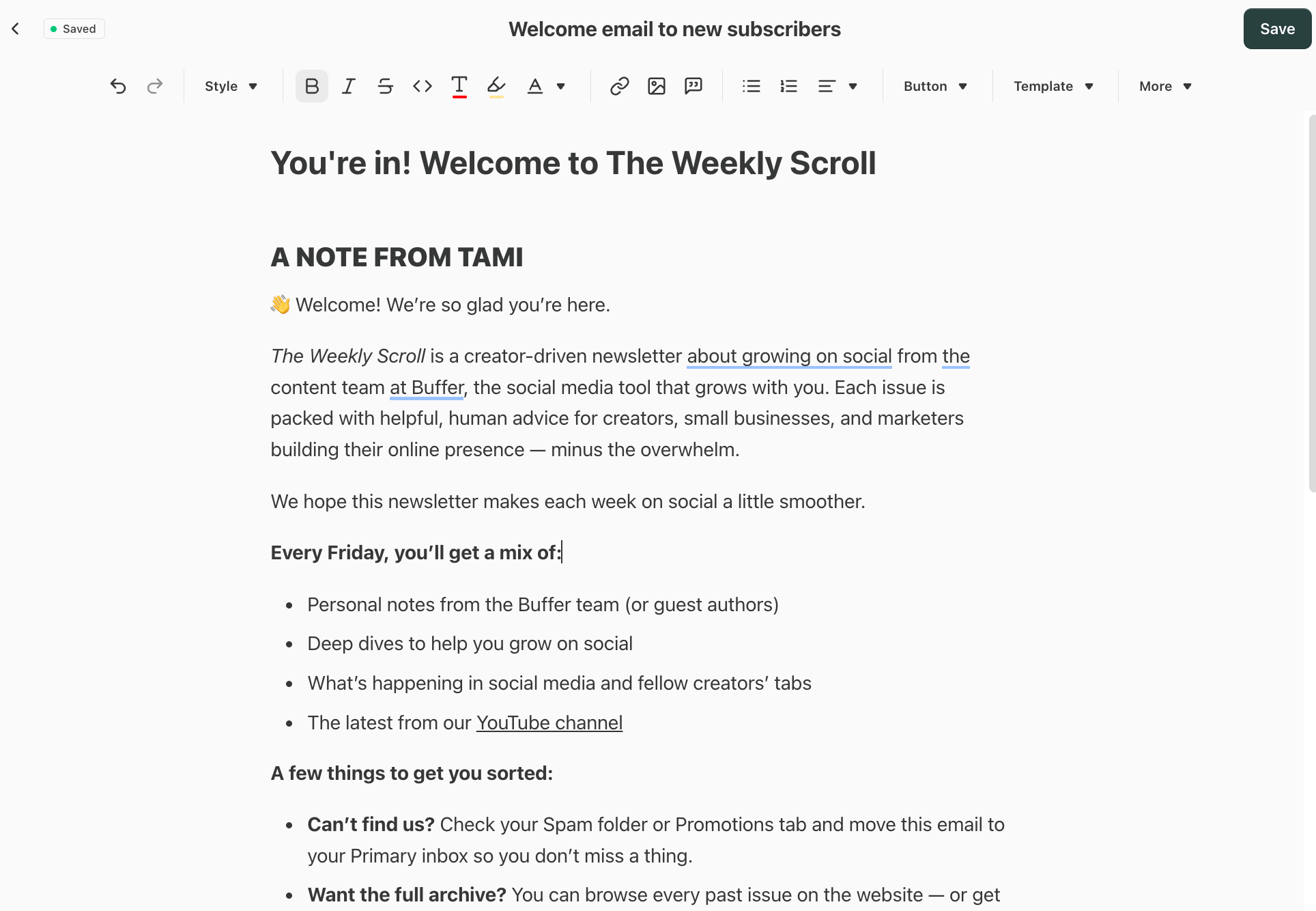
Substack has also been rolling out email automations to more publications since August 2026, so depending on when you read this, you might also be able to set up a short welcome sequence of emails rather than a single email. If you have it, definitely use it.
4. Connect Stripe (even if you're not charging yet)
You don't have to charge anything to sign up for or use Substack, but connecting Stripe is an easy step takes five minutes and means you can turn on paid subscriptions later without a scramble.
It's under Settings → Payments → Connect with Stripe.
Stripe will ask for a business address, your personal details, and a bank account, then send you back to Substack to set up your plans. If you're sure you'll never charge for your publication, feel free to skip this step.
⚡Note: Stripe isn't available everywhere. You can still set up a free publication, but Substack lists a handful of countries (India, Brazil, Indonesia, Mexico, Malaysia, and Thailand at the time of writing) where you can't turn on paid subscriptions, and Stripe's own supported countries list is the one to check for everywhere else.
5. Import an existing email list or previous content
If you have email subscribers elsewhere, import them.
Go to the Subscribers tab, choose Upload a CSV (.csv or .txt both work), and confirm those people gave you permission to email them.
This is what we did with the Weekly Scroll, and it's the biggest reason the move didn't feel like starting from scratch.
If you're also moving old posts over from Medium, Ghost, WordPress, Mailchimp, or beehiiv, that's under Settings → Import/Export.
Just know that everything imports as published, so you can't pick and choose beforehand. You delete what you don't want afterward.
If you don't have a list yet, grab your subscribe link from your publication page and add it to your social bios and website. Substack also gives you an embeddable subscribe form that you can add to your website.
6. Publish a welcome post
Before you start the regular newsletter, publish a post that introduces you and what you'll write about.
It might sound similar to a welcome email, but is more a way to keep your archive from looking empty. Keep it short, detailing who you are, why you're publishing, what to expect and how often, and an invitation to reply or share.
7. Post your first Note
Once your publication is live, write one Note. It doesn't need to be the most clever thing; it can literally be a Hello World post.
In other ideas, say what you've just launched and what it's about, and link to your welcome post. Notes is where most of your early discovery will come from, and it's much less intimidating to post there once you've done it once.
That's everything you need for the initial setup. Everything after this is about what you publish and how you get it in front of people.
What to publish on Substack
Once the publication is set up, the next question is the same one everyone has: what is this thing actually about? Along with, of course, a list of smaller questions like when should I share, or how do I promote?
I haven't found a single right answer, but the newsletters that seem to be doing really well by all publicly available metrics have a clear focus, a sustainable publishing rhythm, and a clear voice and point of view.
Here's how the creators I spoke to (and I) approached it.
Start with a niche, even a loose one
You don't need a hyper-specific niche on day one, but you do need a starting point, because a clear focus is what makes it obvious who should subscribe.
A few questions that help: What do you enjoy writing about, week after week? Who do you want reading it? And what do you know or notice that other people writing about the same thing don't?
That said, don't overthink it. Some of the best newsletters started as someone exploring an idea and figuring out the niche as they went. I'm still adjusting what the Weekly Scroll covers based on what people open and what gets responses, and I'd rather do that than wait for the perfect angle.
Pick a format you'll enjoy repeating
Once you have a topic, decide how you'll structure it. Essay-style deep dives, short weekly roundups, curated links with commentary, interviews, and practical how-tos are all common formats on Substack, and none of them is better than the others. The right one is the one you'll still want to be doing in six months.
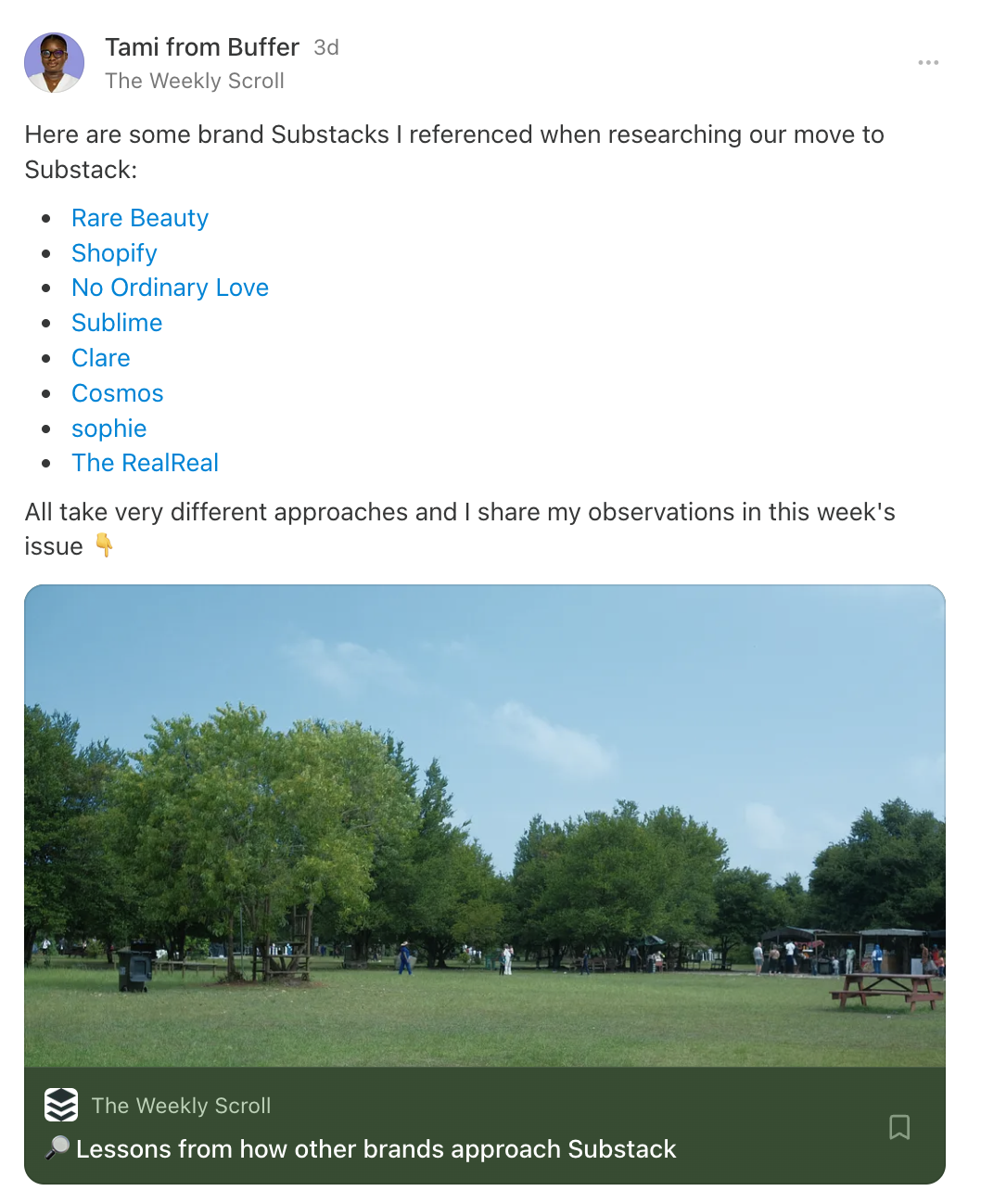
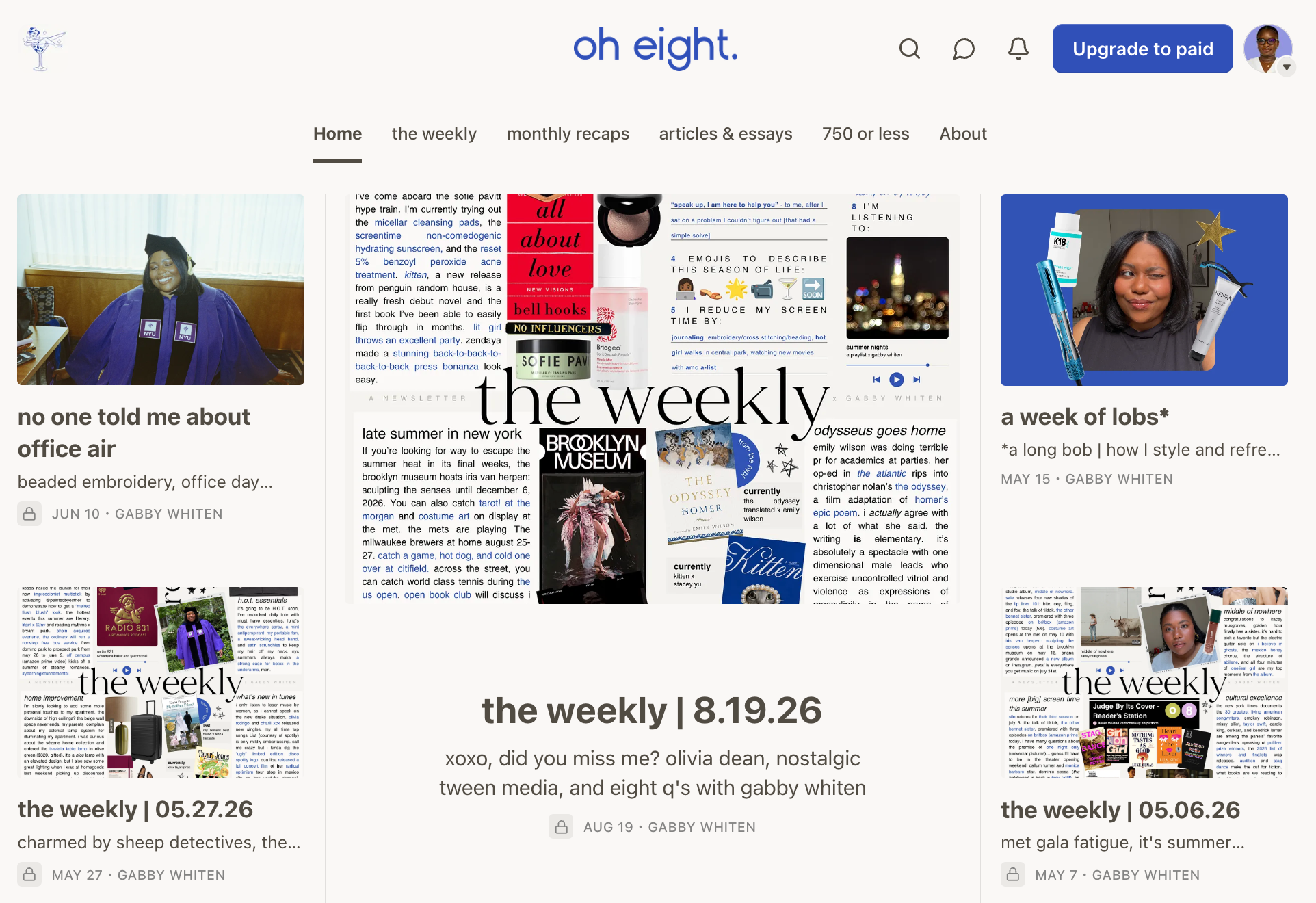
You also don't have to pick a traditional format. Gabby Whiten, who writes Oh Eight, a lifestyle and fashion newsletter, builds an elaborate collage for every issue, and it's become the signal people know her for. If there's something only you would think to do, that's usually a good sign it’ll work on Substack.
For The Weekly Scroll, we cycle through a few formats, from essay-style newsletters to interviews to keep things fresh.
Set a schedule you can actually keep
Consistency matters on Substack, partly because readers get used to a rhythm and partly because a predictable cadence makes Notes easier (you always have something new to point to). But consistency doesn't mean constant.
Once a week is the most common starting point for posting articles on Substack. Some people publish every two weeks, and a few send several times a week. But the best schedule is the one that doesn't burn you out.
If you're unsure, start slower than you think you can manage. It's much easier to add a second post a week later than to walk back from a daily commitment you can't keep.
Optimize your publication for SEO
Most people don't think about this until later, but it can really help with early growth.
Lade Falobi, who writes Marketing for Geeks about product marketing, told me: "I wish I'd known to optimize for search earlier. It's not just about writing great content. You have to make it easy for people to find you."
MillieAmelia, who writes Life Unscripted about travel and creator income, echoes this, with some advice. Two of the five things she'd tell someone starting with no audience are to set your publication categories (so Substack knows who to recommend you to) and to fill in the SEO title and description on every post, because Substack articles can and do rank on Google. Both take a minute, and almost nobody does them.
Choose quality over quantity, especially early on
Frequency gets people to subscribe. Quality is what keeps them from unsubscribing. If you have to choose between shipping something that’s below your standards but on schedule and skipping a week, I’d recommend skipping the week.
That said, Don’t Overthink It. One of my favorite Substackers, Kel Rakowski, shared a recent video advocating for thinking of it less like you’re a legacy publication and more like you’re a person sharing their thoughts in a longer form.
With the what and the how-often sorted, the next question is how to get it in front of people who haven't heard of you yet.
How to grow on Substack
Growth on Substack is slower than on social media, faster than on a standalone email list, and most of it happens inside Substack itself.
So the advice here is less about driving traffic from elsewhere and more about using the things Substack already gives you.
I've written a much more detailed guide on this (it'll be linked at the end of this section), but these are the basics that make the most difference in my experience.
- Turn on Recommendations, then give and ask for them. When you recommend another publication, it's offered to your new subscribers when they sign up, and vice versa when other writers recommend you. Several of the creators I interviewed named this as their biggest single source of new subscribers. Set yours up under Settings → Recommendations, add a handful of publications you actually read, and then ask writers in your space if they'd swap. A short, specific message has worked far better for me than a generic one.
- Post Notes consistently. Notes is where people who've never heard of you find you, because the feed shows people content from writers they don't follow. Short observations, a single useful idea, or a quote from your latest post tend to travel further than a link to it. Restacking other writers' Notes with a comment of your own helps too. Anna Burgess Yang started "restacking quotes from other Substack writers as a way to boost visibility," and found it noticeably increased engagement.
- Give followers a reason to subscribe. Someone who follows you from a Note sees your Notes but doesn't get your emails. So every so often, write a Note that points at the newsletter itself: a preview of this week's issue with a reminder to subscribe, a question you answered for subscribers, or a simple reintroduction to your newsletter.
- Cross-promote with other writers. Guest issues, newsletter swaps, and interviews all work, and Substack makes them easy because you can link straight to another publication's subscribe page. Start with writers at a similar size to you as they're more likely to say yes. You can also check Substack’s new Creator Match feature to find writers with audience overlap.
- Share where you already have an audience, and ask readers to share too. Many creators still grow partly through social media, and it works best when you share a takeaway or a story from the issue rather than just dropping a link. Also, reply to commenters; it's how casual readers turn into super fans.
📚 Related reading: I've gone much deeper on all of this, including what Substack's own founders say the feed rewards and what I learned posting a Note every day for a month, in How to Grow on Substack.
One last thing before you hit publish
If you've made it this far, you have everything you need to set up, publish, and grow a Substack. But if there’s one thing that I’d like to leave you with, it’s the part that's easiest to skip: talking to the people who subscribe.
I’ve always believed that newsletters aren't a one-way channel, and Substack reflects that sentiment.
Subscribers have invited you into their inbox, and every reply, comment, and Chat message is a chance to find out what they need or want from you. That’s why the writers who do best on Substack aren't necessarily the best writers, but make their readers feel like they’re part of something.
If you've been thinking about starting one, consider this your sign. Your first post likely won't be perfect, and your first 10 subscribers might be friends and family. But every newsletter you admire started the same way, with one post and one reader.
Frequently asked questions about using Substack
Is Substack free to use?
Yes. Creating an account, setting up a publication, and sending posts to any number of subscribers is free. Substack only makes money when you do: if you turn on paid subscriptions, it takes 10% of that revenue, and Stripe takes payment processing fees on top.
How much does Substack take from paid subscriptions?
Substack takes 10% of paid subscription revenue. Stripe, which handles payments, adds 2.9% plus $0.30 per transaction and a 0.7% billing fee for subscribers who signed up after July 2024. On an $8/month subscription, that leaves you with roughly $6.62.
What's the difference between subscribers and followers on Substack?
Subscribers get your posts by email (and access to Chat and any paid content). Followers only see your Notes and activity in their Substack app feed, and don't receive emails. Followers exist because Notes exists, so they behave more like a social following. Most growth advice on Substack comes down to turning followers into subscribers.
Do you need an audience to start a Substack?
No. Substack's Recommendations, Notes feed, and app are designed to help new publications get found without an existing following, which is one of the main reasons creators choose it over a standalone email tool. Growth is slow at first either way, and having an audience elsewhere helps, but it isn't a requirement.
Can you schedule posts and Notes on Substack?
You can schedule posts natively: set a date and time in the publish flow and Substack sends the email for you. You can also schedule Notes by clicking the calendar icon in the composer and setting your preferred date and time.
How often should you publish on Substack?
Once a week is the most common cadence for newsletters, and it's a sensible default. Notes is different: because the feed rewards consistency, daily or near-daily Notes tend to do more for discovery than weekly ones. Whatever you pick, choose a schedule you can sustain.
from Buffer Resources https://ift.tt/mTxtUhQ
I currently author Buffer’s Substack, The Weekly Scroll, which has grown to 92K+ subscribers, and I’ve spent the past month publishing to Notes every day. That hands-on, day-to-day experience is why I revisited and reworked this guide.
Ever since we moved The Weekly Scroll, Buffer’s newsletter, over to Substack a few months ago, I’ve been learning the platform from the inside rather than writing about it as an outsider. A lot of the advice and learnings from my first pass at this guide held up, but some of it didn’t, especially since Substack has changed a fair bit since then.
So this reworked guide walks through everything from setting up your account to growing and monetizing your newsletter, with advice from the creators I interviewed and everything I’ve learned firsthand.
Let’s get into it.
Key takeaways
- Substack is a free newsletter platform with a social layer built in. You publish posts that go out by email, and Notes, Chat, and Live sit around them for discovery and community.
- Subscribers and followers are different groups. Subscribers get your emails; followers only see your Notes in the app. You want both, but subscribers are the ones who'll read your newsletter.
- Setting up properly takes about an hour: fill in your profile, set up the publication and its categories, rewrite the welcome email, connect Stripe, import any list you have, and publish a welcome post and a first Note before you start the regular issues.
- Pick a niche you can describe in a sentence and a schedule you can stick to. Fill in the SEO title and description on every post while you're at it, because Substack articles do rank on Google.
- Most growth happens inside Substack, through Recommendations and Notes, so switch those on before you spend time sharing links elsewhere.
- Substack is free until you turn on paid subscriptions, at which point it takes 10% plus Stripe's processing fees.
Jump to a section:
What is Substack (and how does it work)?
Substack is a publishing platform where you write posts and send them to subscribers by email, for free, with the option to charge for some or all of your work.
The platform is part social network and part newsletter tool, as every publisher gets a website, an archive, and a profile in the Substack app, where readers can find you through recommendations and the Notes feed.
The simplest way I've found to explain how it all fits together is in three parts: the content you publish, the audience that finds and follows it, and the money you can (but don't have to) make from it.
Content
There are four content surfaces you can use in Substack.
Posts
Posts are the main draw on the platform. They go to your subscribers' inboxes and live on your publication page, and they can be long-form writing, audio, video, or a mix of all three.
Substack’s audio and video capabilities have evolved a lot. You can run a podcast from Substack and it gives you an RSS feed you can submit to Apple Podcasts, Spotify, and the rest.
You can also publish video posts by uploading a file or recording directly in Substack's Recording Studio (which will look familiar if you’ve ever used Riverside).
Every audio or video post gets a transcript, which you can edit or switch off. And if you connect your YouTube channel under Settings → Connected accounts, Substack will upload your video posts to YouTube when you publish them, along with up to two auto-generated clips as Shorts.
Notes
Notes is Substack's short-form content feed, which works a lot like X or Threads. Anyone on Substack can post Notes, whether or not they have a publication, and they're public, so people who don't follow you can still come across them.
A Note can be plain text, text with up to six images or GIFs, or a video up to five minutes long. There's also a restack button on every post and Note, which reposts it to your own feed with or without your added commentary. Video Notes and clips from your video posts also show up in the app's media tab, which is Substack's vertical, short-form video feed (it launched in early 2025 and works roughly like the TikTok or reels feed, but only for Substack content).
Chat
Chat is a space for conversations with your subscribers, and it only exists inside the app and on your publication page, not by email. Only your subscribers can see it. By default you start the threads, but you can let subscribers start them too, and threads can hold text, photos, image replies, and emoji reactions, so it works a bit like a group chat you host. Substack's direct messages live in the same tab, so this is also where one-to-one conversations with readers and other writers happen.
Live
Live lets you stream video to your audience from the Substack app or your computer. You pick who can watch (everyone on Substack, all your subscribers, or paid subscribers only), you can invite up to two other Substack writers to stream with you, and you can schedule a live in advance. When you go live, Substack notifies your subscribers and adds the stream to their queue.
Once you finish, the recording is saved as a draft post, so you can edit it and send it to the subscribers who didn't catch it live, or cut clips from it to share as Notes. If you already stream with something like OBS or Riverside, Substack supports RTMP, so you can send that feed in rather than using the app's camera.
Audience
On Substack, subscribers and followers are not the same thing (which definitely confused me a bit at first!).
- Subscribing: When someone subscribes to your publication, they get your posts by email as well as all your other content.
- Following: When someone follows you, they only see your Notes and activity in their app feed, but they don't get any emails. Followers exist because Notes exist, so they're more like a social following than a newsletter audience.
This distinction is important because Substack shows you Notes from writers you don't follow and shows your Notes to people who don’t yet follow you. This way, your Notes can reach people who've never heard of you.
And of course, the goal with followers is to eventually turn them into subscribers, since you control and can export your subscriber list anytime and take it to another platform, but you can't export your followers.
Monetization
Substack is free for you and free for your readers unless you turn on paid subscriptions. When you do, you connect Stripe (an external payment platform), set your prices (monthly, annual, and an optional founding tier for readers who want to pay more), and choose what sits behind the paywall. That can be whole posts, part of a post with a free preview, paid-only Chat threads, or paid-only lives.
Substack takes 10% of that revenue, and Stripe takes its processing fees on top. I've broken the actual numbers down in the monetization section, along with when to start charging and what the creators I spoke to and researched put behind their paywalls.
How to use Substack: setting up your publication step by step
While you can technically publish your first Substack post within about five minutes of signing up, I'd hold off. Spending an hour on setup first means that when someone lands on your page from a Note or a recommendation, they see a real publication, not a blank profile with one post. Here's the order I'd do it in.
1. Create your account and fill in your profile
Head to substack.com, sign up, and go straight to Edit profile (click your profile picture, or go to substack.com/profile/edit) before you do anything else. Your profile is what shows up when someone taps your name in Notes, and it's the first thing a potential subscriber checks.
- Add a photo — we went with a face (mine), but a logo works too.
- This is also where you set your handle, which becomes your profile URL and what people use to tag you.
- Create a short bio, and add links to your other socials. The bio should say what you write about and who it's for, in the way you'd say it to someone. So instead of "I'm a marketing expert sharing my thoughts on digital trends," something like "Every week, I break down digital marketing trends into strategies you can actually use."
There's also a Branding section on the same page where you can add a header image and pick an accent color for your profile. It's optional, but it’ll only take a minute and makes the page look polished and personalized.
⚡Under Subscription Privacy, you can choose whether the publications you subscribe to show on your profile. I like to have this visible, along with the specific publications we love here at Buffer, because it helps amplify similar newsletters (recommendations are a big deal on Substack) and what you read says a lot about what you write.
2. Set up your publication
A profile lets you post Notes and follow people, but a publication is the actual newsletter, with its own name, URL, subscribe page, and settings.
Substack creates one for you automatically, and the first time you click the + button on your Home page or Create in your profile page and choose Article, you'll land on it.
To make modifications to the publication, you’ll want to get to your Publisher dashboard, which you can access by selecting the graph icon on the left to take you straight there, or clicking the three dots on your profile, then selecting Publisher dashboard.
At the bottom left, you’ll see Settings, where you can modify all the details about your publication, from your name to payments.
Some immediate things to do in your Settings:
- Pick a name and your URL. You can change both later, but that may confuse subscribers, and you can't set up a redirect (to my knowledge), so choose wisely. If you'd rather use your own domain, that's under Settings → Domain. It's a one-time $50 fee, and Substack needs a subdomain like www. rather than the bare domain (here's how).
- Pick a category or two from the drop-down. Substack uses them to surface your publication in search and discovery and to decide which leaderboard you show up on.
- Upload a logo and a cover image, and pick your homepage layout and colors.
- Write a one-line description. It shows up on your Welcome page (yourname.substack.com/welcome), which is what first-time visitors see before your homepage.
Substack also gives you a setup checklist in your dashboard, which is handy if you're doing this over a few sessions.
3. Write your welcome email
New subscribers get an automatic welcome email, and this is a great opportunity to give them a taste of what to expect from your content.
State who you are, what they'll get, how often, and ask them one question they can reply to. Replies boost deliverability and, more importantly, they're how you learn more about who’s opening and reading your emails.
You'll find them under Settings → Emails, and there are actually four types of you can create: one each for free, paid, imported, and founding subscribers. I recommend starting with the free one, although the imported one matters more if you're bringing a list over (more on that in step 5).
Substack has also been rolling out email automations to more publications since August 2026, so depending on when you read this, you might also be able to set up a short welcome sequence of emails rather than a single email. If you have it, definitely use it.
4. Connect Stripe (even if you're not charging yet)
You don't have to charge anything to sign up for or use Substack, but connecting Stripe is an easy step takes five minutes and means you can turn on paid subscriptions later without a scramble.
It's under Settings → Payments → Connect with Stripe.
Stripe will ask for a business address, your personal details, and a bank account, then send you back to Substack to set up your plans. If you're sure you'll never charge for your publication, feel free to skip this step.
⚡Note: Stripe isn't available everywhere. You can still set up a free publication, but Substack lists a handful of countries (India, Brazil, Indonesia, Mexico, Malaysia, and Thailand at the time of writing) where you can't turn on paid subscriptions, and Stripe's own supported countries list is the one to check for everywhere else.
5. Import an existing email list or previous content
If you have email subscribers elsewhere, import them.
Go to the Subscribers tab, choose Upload a CSV (.csv or .txt both work), and confirm those people gave you permission to email them.
This is what we did with the Weekly Scroll, and it's the biggest reason the move didn't feel like starting from scratch.
If you're also moving old posts over from Medium, Ghost, WordPress, Mailchimp, or beehiiv, that's under Settings → Import/Export.
Just know that everything imports as published, so you can't pick and choose beforehand. You delete what you don't want afterward.
If you don't have a list yet, grab your subscribe link from your publication page and add it to your social bios and website. Substack also gives you an embeddable subscribe form that you can add to your website.
6. Publish a welcome post
Before you start the regular newsletter, publish a post that introduces you and what you'll write about.
It might sound similar to a welcome email, but is more a way to keep your archive from looking empty. Keep it short, detailing who you are, why you're publishing, what to expect and how often, and an invitation to reply or share.
7. Post your first Note
Once your publication is live, write one Note. It doesn't need to be the most clever thing; it can literally be a Hello World post.
In other ideas, say what you've just launched and what it's about, and link to your welcome post. Notes is where most of your early discovery will come from, and it's much less intimidating to post there once you've done it once.
That's everything you need for the initial setup. Everything after this is about what you publish and how you get it in front of people.
What to publish on Substack
Once the publication is set up, the next question is the same one everyone has: what is this thing actually about? Along with, of course, a list of smaller questions like when should I share, or how do I promote?
I haven't found a single right answer, but the newsletters that seem to be doing really well by all publicly available metrics have a clear focus, a sustainable publishing rhythm, and a clear voice and point of view.
Here's how the creators I spoke to (and I) approached it.
Start with a niche, even a loose one
You don't need a hyper-specific niche on day one, but you do need a starting point, because a clear focus is what makes it obvious who should subscribe.
A few questions that help: What do you enjoy writing about, week after week? Who do you want reading it? And what do you know or notice that other people writing about the same thing don't?
That said, don't overthink it. Some of the best newsletters started as someone exploring an idea and figuring out the niche as they went. I'm still adjusting what the Weekly Scroll covers based on what people open and what gets responses, and I'd rather do that than wait for the perfect angle.
Pick a format you'll enjoy repeating
Once you have a topic, decide how you'll structure it. Essay-style deep dives, short weekly roundups, curated links with commentary, interviews, and practical how-tos are all common formats on Substack, and none of them is better than the others. The right one is the one you'll still want to be doing in six months.
You also don't have to pick a traditional format. Gabby Whiten, who writes Oh Eight, a lifestyle and fashion newsletter, builds an elaborate collage for every issue, and it's become the signal people know her for. If there's something only you would think to do, that's usually a good sign it’ll work on Substack.
For The Weekly Scroll, we cycle through a few formats, from essay-style newsletters to interviews to keep things fresh.
Set a schedule you can actually keep
Consistency matters on Substack, partly because readers get used to a rhythm and partly because a predictable cadence makes Notes easier (you always have something new to point to). But consistency doesn't mean constant.
Once a week is the most common starting point for posting articles on Substack. Some people publish every two weeks, and a few send several times a week. But the best schedule is the one that doesn't burn you out.
If you're unsure, start slower than you think you can manage. It's much easier to add a second post a week later than to walk back from a daily commitment you can't keep.
Optimize your publication for SEO
Most people don't think about this until later, but it can really help with early growth.
Lade Falobi, who writes Marketing for Geeks about product marketing, told me: "I wish I'd known to optimize for search earlier. It's not just about writing great content. You have to make it easy for people to find you."
MillieAmelia, who writes Life Unscripted about travel and creator income, echoes this, with some advice. Two of the five things she'd tell someone starting with no audience are to set your publication categories (so Substack knows who to recommend you to) and to fill in the SEO title and description on every post, because Substack articles can and do rank on Google. Both take a minute, and almost nobody does them.
Choose quality over quantity, especially early on
Frequency gets people to subscribe. Quality is what keeps them from unsubscribing. If you have to choose between shipping something that’s below your standards but on schedule and skipping a week, I’d recommend skipping the week.
That said, Don’t Overthink It. One of my favorite Substackers, Kel Rakowski, shared a recent video advocating for thinking of it less like you’re a legacy publication and more like you’re a person sharing their thoughts in a longer form.
With the what and the how-often sorted, the next question is how to get it in front of people who haven't heard of you yet.
How to grow on Substack
Growth on Substack is slower than on social media, faster than on a standalone email list, and most of it happens inside Substack itself.
So the advice here is less about driving traffic from elsewhere and more about using the things Substack already gives you.
I've written a much more detailed guide on this (it'll be linked at the end of this section), but these are the basics that make the most difference in my experience.
- Turn on Recommendations, then give and ask for them. When you recommend another publication, it's offered to your new subscribers when they sign up, and vice versa when other writers recommend you. Several of the creators I interviewed named this as their biggest single source of new subscribers. Set yours up under Settings → Recommendations, add a handful of publications you actually read, and then ask writers in your space if they'd swap. A short, specific message has worked far better for me than a generic one.
- Post Notes consistently. Notes is where people who've never heard of you find you, because the feed shows people content from writers they don't follow. Short observations, a single useful idea, or a quote from your latest post tend to travel further than a link to it. Restacking other writers' Notes with a comment of your own helps too. Anna Burgess Yang started "restacking quotes from other Substack writers as a way to boost visibility," and found it noticeably increased engagement.
- Give followers a reason to subscribe. Someone who follows you from a Note sees your Notes but doesn't get your emails. So every so often, write a Note that points at the newsletter itself: a preview of this week's issue with a reminder to subscribe, a question you answered for subscribers, or a simple reintroduction to your newsletter.
- Cross-promote with other writers. Guest issues, newsletter swaps, and interviews all work, and Substack makes them easy because you can link straight to another publication's subscribe page. Start with writers at a similar size to you as they're more likely to say yes. You can also check Substack’s new Creator Match feature to find writers with audience overlap.
- Share where you already have an audience, and ask readers to share too. Many creators still grow partly through social media, and it works best when you share a takeaway or a story from the issue rather than just dropping a link. Also, reply to commenters; it's how casual readers turn into super fans.
📚 Related reading: I've gone much deeper on all of this, including what Substack's own founders say the feed rewards and what I learned posting a Note every day for a month, in How to Grow on Substack.
One last thing before you hit publish
If you've made it this far, you have everything you need to set up, publish, and grow a Substack. But if there’s one thing that I’d like to leave you with, it’s the part that's easiest to skip: talking to the people who subscribe.
I’ve always believed that newsletters aren't a one-way channel, and Substack reflects that sentiment.
Subscribers have invited you into their inbox, and every reply, comment, and Chat message is a chance to find out what they need or want from you. That’s why the writers who do best on Substack aren't necessarily the best writers, but make their readers feel like they’re part of something.
If you've been thinking about starting one, consider this your sign. Your first post likely won't be perfect, and your first 10 subscribers might be friends and family. But every newsletter you admire started the same way, with one post and one reader.
Frequently asked questions about using Substack
Is Substack free to use?
Yes. Creating an account, setting up a publication, and sending posts to any number of subscribers is free. Substack only makes money when you do: if you turn on paid subscriptions, it takes 10% of that revenue, and Stripe takes payment processing fees on top.
How much does Substack take from paid subscriptions?
Substack takes 10% of paid subscription revenue. Stripe, which handles payments, adds 2.9% plus $0.30 per transaction and a 0.7% billing fee for subscribers who signed up after July 2024. On an $8/month subscription, that leaves you with roughly $6.62.
What's the difference between subscribers and followers on Substack?
Subscribers get your posts by email (and access to Chat and any paid content). Followers only see your Notes and activity in their Substack app feed, and don't receive emails. Followers exist because Notes exists, so they behave more like a social following. Most growth advice on Substack comes down to turning followers into subscribers.
Do you need an audience to start a Substack?
No. Substack's Recommendations, Notes feed, and app are designed to help new publications get found without an existing following, which is one of the main reasons creators choose it over a standalone email tool. Growth is slow at first either way, and having an audience elsewhere helps, but it isn't a requirement.
Can you schedule posts and Notes on Substack?
You can schedule posts natively: set a date and time in the publish flow and Substack sends the email for you. You can also schedule Notes by clicking the calendar icon in the composer and setting your preferred date and time.
How often should you publish on Substack?
Once a week is the most common cadence for newsletters, and it's a sensible default. Notes is different: because the feed rewards consistency, daily or near-daily Notes tend to do more for discovery than weekly ones. Whatever you pick, choose a schedule you can sustain.
Comments
Post a Comment