
Have you ever had that eerie feeling of entering a room and just knowing people have been talking about you?
That happens to your brand every day. People share product recommendations in Instagram Stories, leave feedback in TikTok comments, and (sadly) most of those posts never tag you.
So your notifications only show a small part of what people are saying about your brand.
That’s where social listening comes in — it shows you what people say about you, your competitors, and your industry when you’re not looking.
In this guide, I'll break down what social listening is, how it differs from social monitoring, and how to build your own social listening strategy.
Key takeaways
- Social listening is tracking and analyzing online conversations about your brand, competitors, and industry, including posts that don't tag you, and using what you find to shape your strategy.
- Social media monitoring tracks what people say to you (tags, mentions, DMs). Social listening looks at what they say about you and why.
- The main benefits of social listening are deeper audience insight, faster reputation management, earlier trend spotting, better product decisions, and sharper competitive positioning.
- A workable social listening strategy has five steps: set goals, mine your own comments, pick your keywords, choose tools, and turn the data into decisions.
- Start with monitoring your own comments and DMs. Add listening once you're keeping up with those.
Jump to a section:
What is social listening?
Social listening (or social media listening) is tracking and analyzing the unfiltered opinions people share about your brand, products, competitors, and industry on social media, including the posts that don’t tag you. Think of it as being a fly on the wall. What you learn shapes:
- The content you create
- The product changes you make
- How you market and position your brand
The key word is analyzing. Replying to a post that tags you is monitoring. Listening goes a step further — it’s noticing the pattern across hundreds of posts and doing something about it.
Say you sell running shoes. Over a few weeks, you notice dozens of TikTok posts and comments from runners saying your shoes fit half a size small. None of them tag you or comment on your posts.
Replying to one of them because you saw the post in your FYP is customer care. Spotting the pattern, adding a fit note to your product pages, and flagging it to your product team is social listening.
Social listening vs. social media monitoring
Social media monitoring tracks what people say directly to your brand, like tags, mentions, and DMs, so you can respond. Social listening analyzes the wider conversation about your brand, competitors, and industry so you can understand why people feel the way they do.
People often use the two terms interchangeably online, but there's a difference.
"Social media monitoring is the baseline: keeping track of direct mentions, tags, and messages so you can respond quickly. It's important for customer care, but it only shows you what people say to you,” says social media consultant Annie-Mai Hodge.
“Social listening is the bigger picture: analyzing the full spectrum of conversations around your brand, your industry, and even cultural trends your audience cares about. It tells you not just what is being said, but why.”
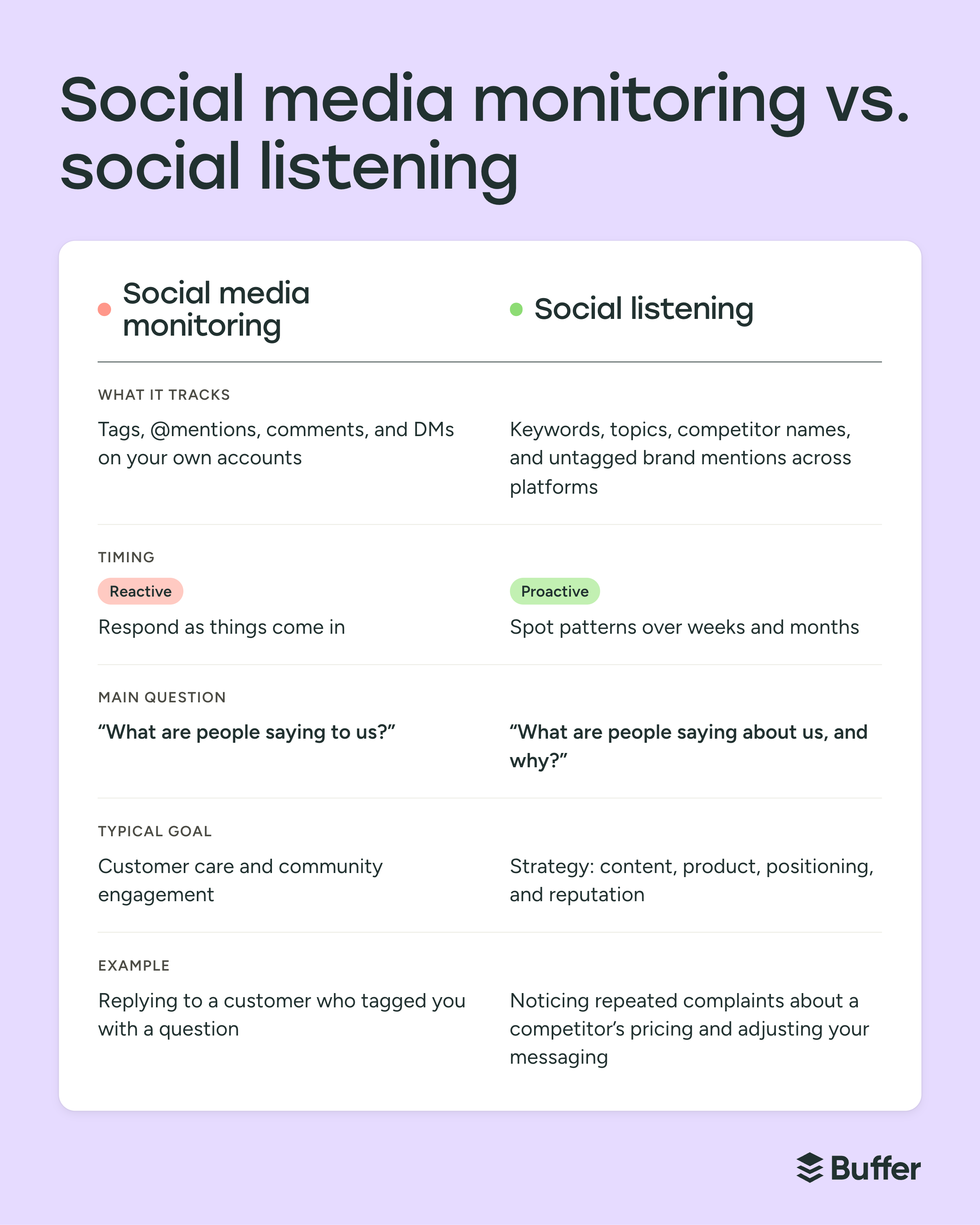
Here's how they compare side by side:
| Social media monitoring | Social listening | |
|---|---|---|
| What it tracks | Tags, @mentions, comments, and DMs on your own accounts | Keywords, topics, competitor names, and untagged brand mentions across platforms |
| Timing | Reactive: respond as things come in | Proactive: spot patterns over weeks and months |
| Main question | “What are people saying to us?” | “What are people saying about us, and why?” |
| Typical goal | Customer care and community engagement | Strategy: content, product, positioning, and reputation |
| Example | Replying to a customer who tagged you with a question | Noticing repeated complaints about a competitor’s pricing and adjusting your messaging |
Social monitoring and listening isn’t either/or — the two work together.
- Without social media monitoring, you aren't responding to comments and mentions from your audience, so you miss the connection that builds a solid online community.
- Without social media listening, you aren't finding out what your community needs before they ask, so you can't address it in your content or products.
If you’re just kickstarting your strategy, focus on acing monitoring first. Engage with the community you've already built: respond to comments, DMs, and posts that mention you. Once you're comfortably doing that consistently, add listening to the mix.
Many social listening tools handle both monitoring and listening tasks (more on that later).
The top 5 benefits of social listening
Social listening gives you insight that monitoring alone can't: what your audience thinks when they aren't talking to you. Here are five ways it pays off.
1. You get deeper insights about your audience
Think of social listening like tuning into a radio station where your audience is freely talking about your industry, products, and competitors. You hear their struggles, how your product fits into their lives, and what you'd need to change to meet their needs.
"So many social conversations happen without brand mentions, which means if you're only watching your @notifications, you're missing the majority of valuable feedback and insight," says Annie-Mai.
"That's where social listening becomes more than monitoring because it's about spotting early patterns in what customers are saying, identifying rising pain points or opportunities, and feeding that back into strategy."
When your content is rooted in what your audience actually says, you spend less time guessing what will work.
2. You protect your brand reputation
Customers talk about your brand even when they don't tag you. Skip social listening, and you miss that feedback, whether it's a complaint or praise, along with the chance to provide a great customer experience.
A listening habit also prepares you for crisis management. If you notice a negative conversation building about your brand, you can step in and address it before it does too much damage.
Poppi shows how to do that best. People spent months roasting its original root beer online.
The brand first posted a carousel of the harshest comments itself, then announced a reformulated root beer, saying it had “heard you loud and clear.”
It turned criticism into a reason to talk to customers.
Social listening also helps your customer advocacy team, who can offer support to customers even when your account isn't tagged.
3. You spot emerging trends early
Social listening is the ultimate first-mover advantage. When you’re listening to larger conversations in your industry and what people want, you notice patterns, trending topics, and shifts in customer sentiment before everyone catches up.
For example, Sprite launched Sprite + Tea after noticing a jump in people adding tea bags to their Sprite on social media (specifically FoodTok). The brand turned a DIY trend into a product.
"This was an organic, consumer-first insight," says Kate Schaufelberger, Sprite's North America brand director. "It just felt like a really ripe opportunity to listen to that consumer innovation idea as a foundation and jumping-off point."
Can you spot trends by watching only your own account? Sometimes. But if you only hear from people who tag you, you’re in an echo chamber. Those people already know your brand, so you miss what everyone else thinks, including people who’ve never heard of you and the ones who left without saying why.
4. You can contribute to product development
Regular social listening keeps you up to date on conversations about your industry and product. That can help you create new products or improve existing ones based on how customers actually use them.
Cassey Ho, founder of Popflex Active, does this like a pro. She launched the Corset Zip Jacket after hearing "I'm so SICK of dropped shoulders!" over and over from her audience. So now her product’s fitted design comes with zippered pockets, thumbholes, and built-in convertible mittens.
Her customers' complaints were the exact brief she used to develop products they’d love.
Using social listening to shape your product roadmap isn't usually where you start. But once your listening habit has been running for a while, you can expect a more direct impact on your business.
5. You find your edge against competitors
Social listening includes competitive analysis: understanding how your target audience sees your rivals. That tells you which of your strengths to lean on in your marketing campaigns and which features your buyers need next. (For a full process, see our guide to competitor analysis.)
"When we noticed recurring Reddit threads about creators being frustrated with our competitor's pricing, we built targeted campaigns around our migration tools and highlighted those in creator outreach," says Tyler Denk, CEO of Beehiiv.
"Similarly, when people on X were asking how to get more subscribers without paying for ads, we doubled down on showcasing our Boosts product, which lets creators cross-promote and pay only for verified signups. These insights directly shape what features we promote, what guides we publish, and even how we adjust our onboarding flows."
introducing: the Boosts Recommendation Widget
— beehiiv 🐝 (@beehiiv) February 8, 2024
seamlessly tap into the Boosts network across any third-party platform or website
you earn more revenue, we'll handle the verification and payouts 🤝 pic.twitter.com/jm37OSBVuD
Tyler's example shows how listening can reshape your marketing messages; especially when people are frustrated with a competitor, you can turn it in your favor.
Now that you know what social listening can do for you, let’s cover how to actually make it a part of your social media strategy.
How to build a social listening strategy in 5 steps
Social listening — like most things in life — benefits more from consistency than intensity. Instead of spending hours crawling through different platforms, pick a narrow focus, check in on a regular schedule, and use social media listening tools (where you can) to speed things up.
Step 1. Set concrete goals
Social listening can do a lot — help you develop products, spy on competitors, gather feedback, inform marketing decisions — but you don't need it to do everything.
Decide what's the number one thing you want your listening to achieve, aka set some solid goals you can actually track.
- Want to understand brand sentiment? Track conversations that mention your brand to get an honest read on public opinion.
- Want to improve your marketing campaigns? Focus on what your target audience talks about on social media — what they like, don’t like, wish for, and care about. Use these insights to create your next post.
- Want to stand out against competitors? Look at conversations about your product's top alternatives. Note what people like and dislike about other brands, then sharpen how you position yourself.
Clear goals also make it easier to report on your social listening results, and they make the next step quicker.
Step 2. Start with your own comments and DMs
Before you start veering outside your account, trace a few steps back and read your own comment section and DMs. I promise you'll find a few forgotten notes that contain gems: questions, feature requests, and complaints your audience has been telling you all along.
The catch is that comments are scattered across all platforms you’re active on. That’s why you need a social media management tool like Buffer, which puts them all into one place.
You get one focused view of all your comments, and you can reply to them from Buffer itself.
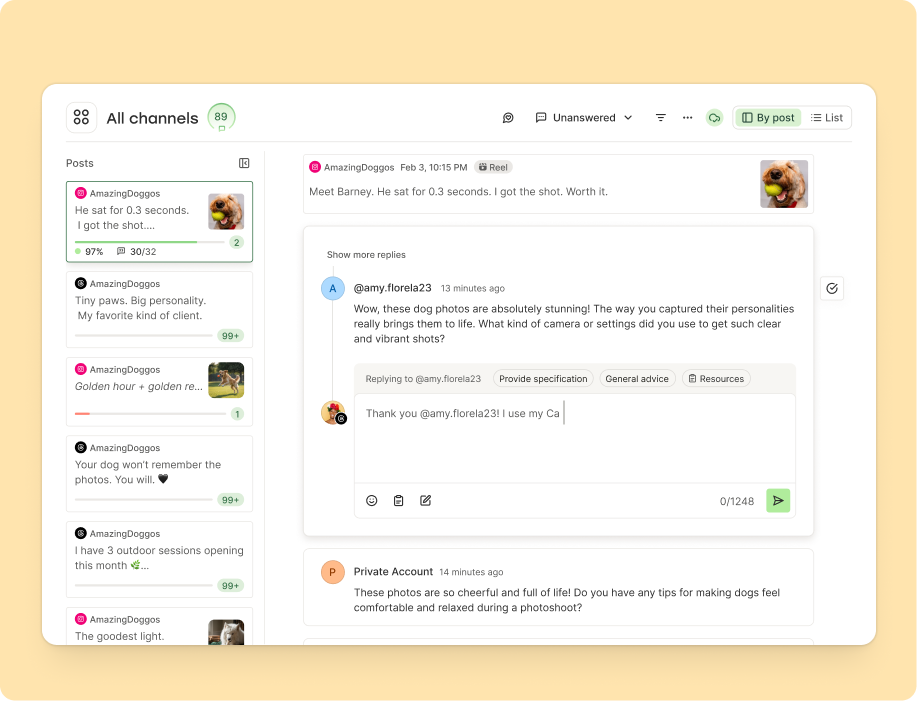
Once your comments live in one place, spotting patterns becomes easier. You might notice consumers often praise one product or ask similar questions. Keep going, tally the themes that repeat (questions, requests, complaints, praise), and act on the biggest one.
Step 3. Decide the topics and keywords you will monitor
Once you've set up a system to respond to comments and DMs, take a more proactive approach and shortlist the keywords and topics you'll monitor across social channels.
Every platform has a search function, so you can start there for free. Keep it to a few targeted keywords that match your goals.
"The easiest way to build social listening skills is to go beyond your own notifications. Start tracking keywords in your niche, notice the questions or frustrations people raise in comment sections, and pay attention to the language your audience actually uses," says Annie-Mai.
"Over time, you'll see patterns, and those insights can shape your content themes, your tone, and even the partnerships or products you prioritize."
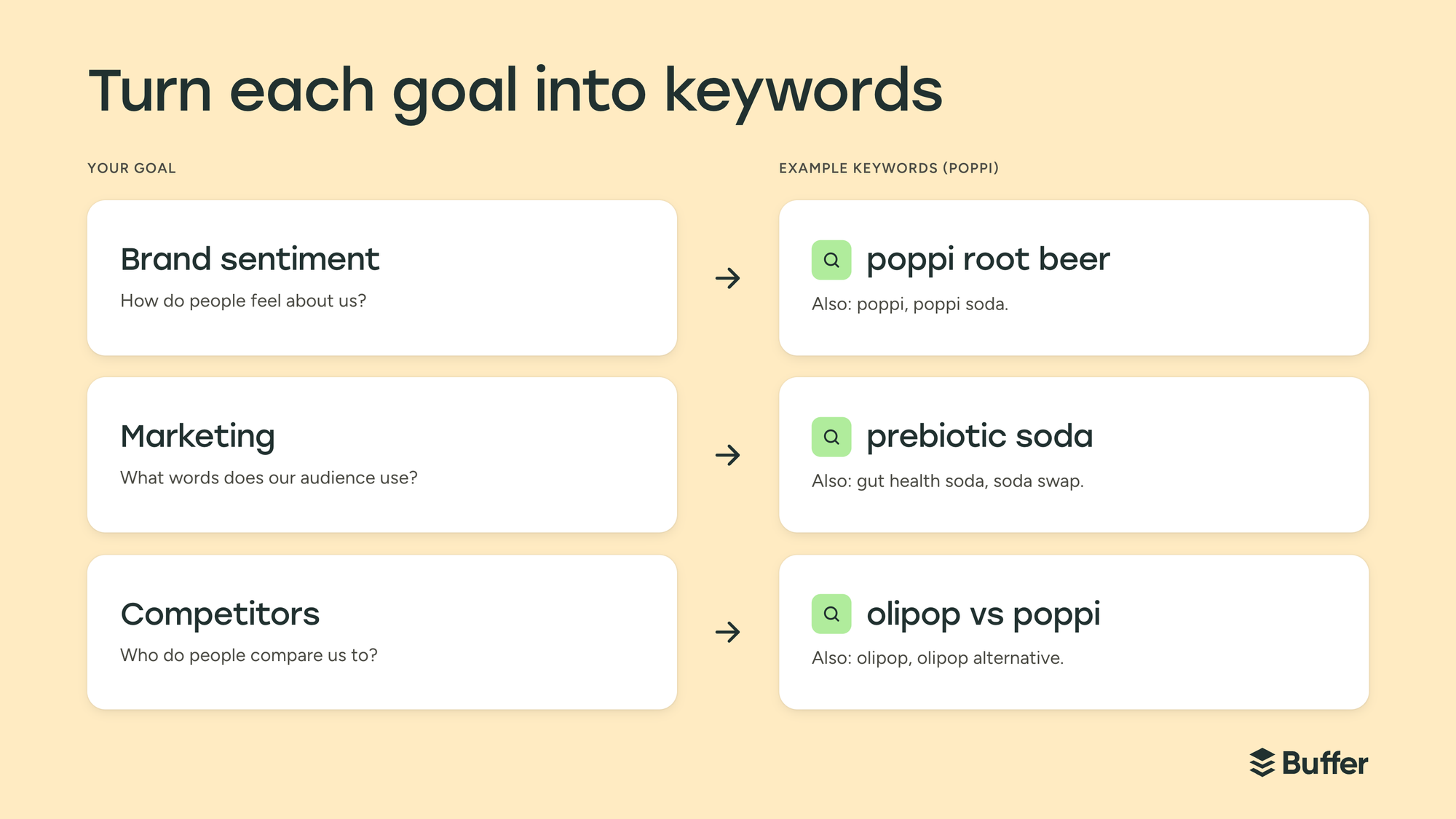
Your keywords come straight from the goals you set in step one:
- If your goal is understanding brand sentiment, shortlist keywords related to your brand name and products, then look for posts with negative sentiment and note how people talk about you. Poppi's team, for example, would watch "poppi root beer" to catch posts that never tag the brand.
- If your goal is to improve marketing performance, list the keywords your potential customers use most often. This helps you join conversations where your product is a natural fit. For Poppi, that could be "prebiotic soda" or "healthy soda swap."
- If you want to position yourself as the better alternative to a competitor, add keywords related to your rivals’ brand, too. You can spot negative sentiment about their products, see how consumers compare you two, and step in if/when the time is right.
Don't forget to check Reddit regularly, too. Its threads are some of the most candid product conversations online. And there’s a subreddit for every possible thing imaginable. If you’re a skincare brand, for instance, hang out in spaces like:
- r/SkincareAddiction
- r/SkincareAddicts
- r/beauty
- r/skincarehobbyists
- …and so many more
You can also search your brand’s name in Reddit's search bar and note which subreddits keep coming up — that's where your audience hangs out.
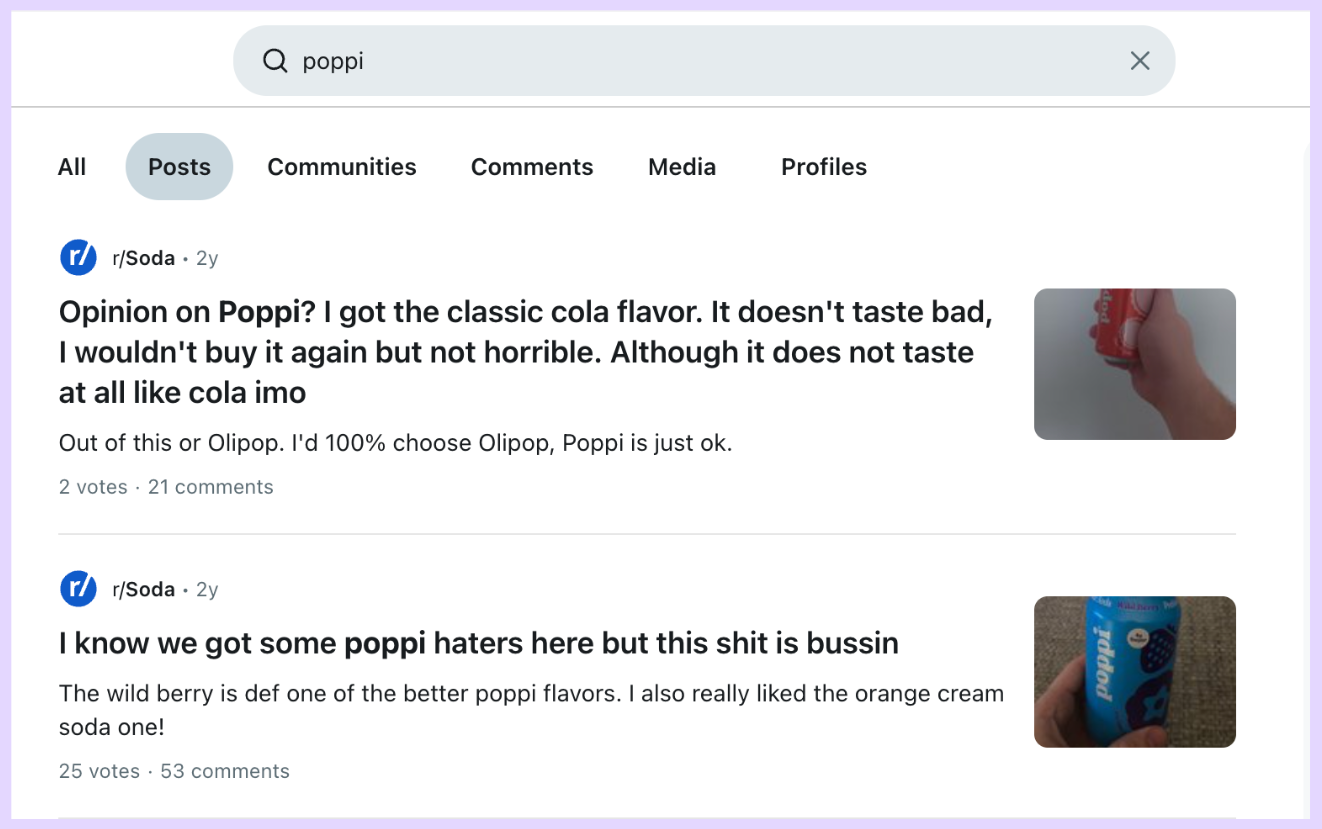
Revisit your keyword library every quarter based on what you've learned and how your goals have changed. If people keep calling your product a "dupe" or comparing it to a rival, for example, add those words to the list.
Step 4. Choose the right social listening tools
Every major social platform has its own search. But sifting through thousands of posts to find a smidge of useful info is back-breaking work (on top of everything else on your plate!).
That's why the right social listening tool is worth it: it speeds up conversation tracking so you get useful insights without spending hours searching manually. Here are my three favorites:
- Exploding Topics, best for spotting trends early. A freemium tool for finding trends before they go viral so you can join the conversation and use it to inform your overall strategy.
- Brand24, best for broad coverage. Choose Brand24 when you want a comprehensive platform with insights from social media plus blogs, forums, and podcasts. It's a great tool, but the price can be a barrier. It's worth it when you're using social listening for bigger jobs like market research, where the ROI can justify the cost.
- YouScan, best for image and logo recognition. YouScan has a special place in my heart for its image monitoring. You can spot your logo in the wild and never miss a mention of your product, and it's great for catching dupes. Like Brand24, its main drawback is price. Invest in it only if you're missing lots of relevant mentions because your logo was in a post but your name wasn't.
How social listening tools work
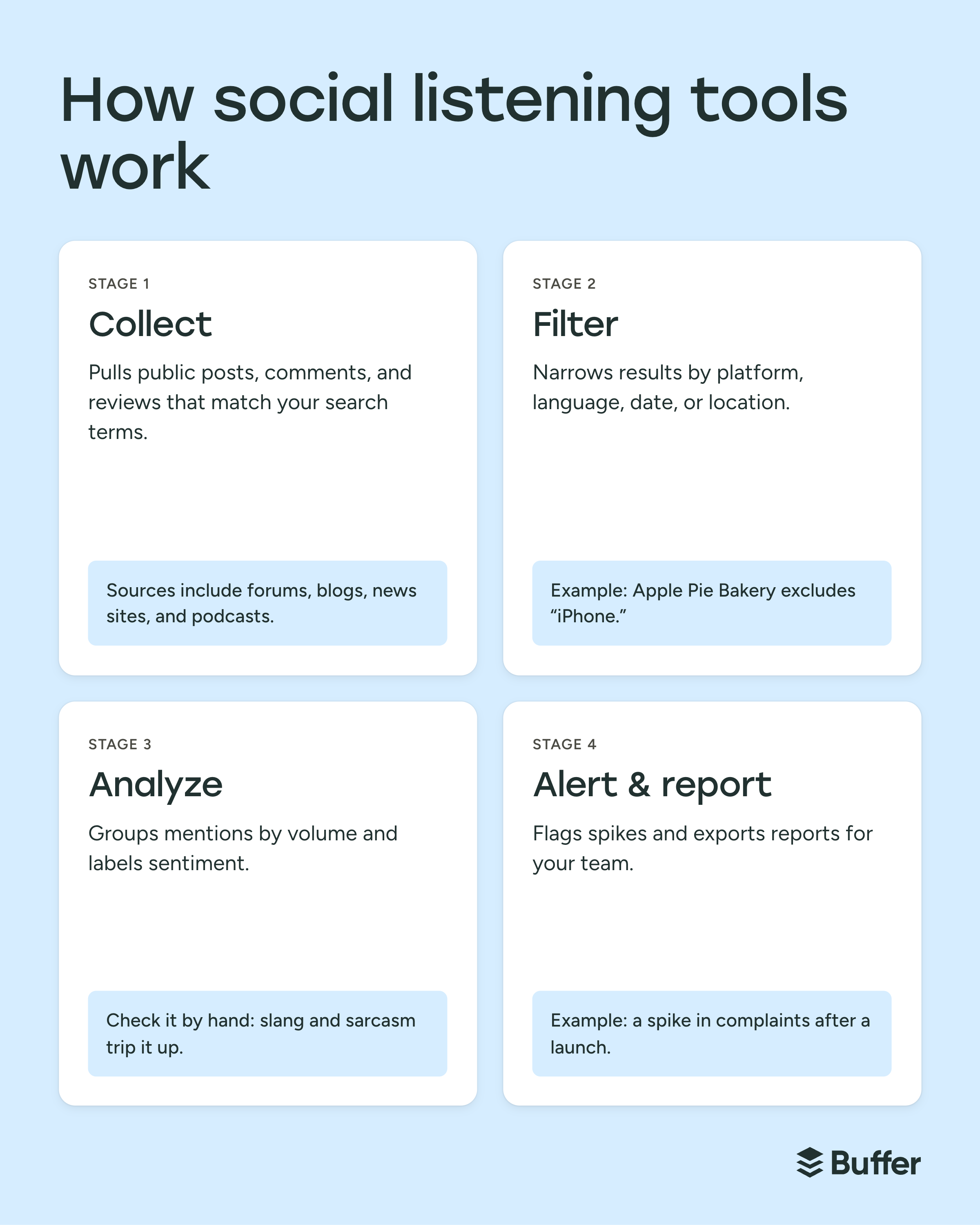
Social listening tools collect public posts that match the keywords, brand names, and topics you set up, then sort and analyze them so you don't have to read every post yourself. Most follow the same four stages:
- Collect. The tool pulls public posts, comments, and (depending on the tool) blogs, forums, news sites, podcasts, and reviews that match your search terms.
- Filter. You narrow results by platform, language, date, or location, and exclude irrelevant keywords. A brand called "Apple Pie Bakery" would exclude "iPhone," for example.
- Analyze. The tool groups mentions by volume over time and labels sentiment as positive, negative, or neutral. Some can also recognize your logo in images.
- Alert and report. You get notified about spikes (useful for spotting a crisis early) and can export reports to share with your team.
Step 5. Analyze the data and use it to refine your strategy
Social listening platforms can surface negative sentiment, useful insights, and industry trends. But listening means turning that data into decisions you can act on.
Many social listening tools will flag posts with negative feedback and show you a sentiment breakdown. But back it up with manual analysis, because software alone can't catch every nuance. They might misconstrue slang or sarcasm or misunderstand what people actually meant.
When a tool collects every post for a keyword you're tracking, read through them and look for patterns:
- Are posts with a common theme getting more traction than others?
- Are there repeated complaints about a feature?
- Are people suddenly talking about a new topic?
That extra layer of human judgment turns raw data into findings you can use. Your social media analytics work cohesively here, too. Let’s say you sell cast-iron pans and see:
- Lots of comments and DMs asking how to season the pans
- Lots of content from your keyword search about people struggling to season pans properly
- Your care-tip guides on getting the most saves
👆 That’s a theme worth leaning into!
Once you've spotted the patterns, turn them into actions. For example:
- If a competitor launches a much-needed feature and gets a lot of buzz, pass it to the relevant team (product or sales) to decide whether your roadmap or sales strategy needs adjusting.
- If a topic in your industry suddenly spikes, check whether you can join the trend to boost your reach.
- If you find recurring complaints from your target audience, look at how you can address them as a business. Can you add a feature? Or do you need to market your existing products better?
The last thing you want is for your social listening insights to collect dust. The haircare brand Fix My Curls is a good example. After a lot of customer feedback about its unattractive packaging, it took the comments to heart and redesigned the packaging.
"Sometimes, social listening might help in highlighting product issues that need to be addressed quickly. And other times, it could surface the language customers are naturally using so you can reflect that in campaigns," says Annie-Mai.
"The end goal is always the same: to turn passive conversations into active intelligence that shapes content, community management, and even wider brand decisions."
3 social listening examples
Here are three brands that turned what people were saying into action:
| Brand | What they heard | What they did |
|---|---|---|
| Grillo’s Pickles | Customers complained the lid leaked and hurt their fingernails | Redesigned the jar with a twist-off lid |
| Crayola | Fans asking for retired colors | Brought back eight colors |
| Tree Hut | Requests for year-round Cinnamon Dolce | Made lotion and wash versions, then featured it in a Super Bowl ad |
1. Grillo's Pickles fixed its lid
Grillo’s Pickles, an American fresh pickle brand, kept hearing that the lift-up lid leaked brine and cost people their fingernails.
The brand listened and fixed the issue by rolling out a twist-off lid.
2. Crayola brought back retired colors
Fans had been asking Crayola to bring back its retired colors for years. In 2025, Crayola brought back eight of them and posted about the return on Instagram.
How did they land on which colors to bring back? Social listening, baby.
“We receive fan requests for bringing back retired colors all the time,” said Crayola Chief Marketing Officer Victoria Lozano. “We keep track of what colors consumers are asking for.”
3. Tree Hut expanded Cinnamon Dolce
Tree Hut, a bath and body care brand, launched a seasonal scent, Cinnamon Dolce, and fans love it so much that they wanted it to be available all year round.
“For years, people have asked us to bring it back full time, bring it back nationally, and bring it into other forms like shave oil or body wash,” said Sarah Craig, associate director of integrated media at Tree Hut’s parent company, Naterra.
So the brand expanded it into a body lotion and a foaming wash, and put it at the end of its 2026 Super Bowl ad.
Social listening FAQ
What is social listening in simple terms?
Social listening means tracking what people say about your brand, your competitors, and your industry online, even when they don’t tag you. Then you use what you learn to make better decisions about your marketing and product. Say a few customers comment that your shoes run small. Replying to them is monitoring. Noticing it keeps coming up and adding a sizing note to your product page is listening.
What's the difference between social listening and social monitoring?
Social monitoring tracks what people say directly to you (tags, @mentions, comments, and DMs) so you can respond. Social listening analyzes broader conversations about your brand, competitors, and industry to understand customer sentiment and spot patterns. Monitoring is reactive and focused on customer care, while listening is proactive and feeds into strategy.
Can you do social listening for free?
Yes. Start with the comments, DMs, and mentions on your own accounts: Buffer's Community brings all your comments into one place across multiple social media channels. Then use each platform's built-in search to look up your brand name, competitors, and keywords. Free tools like Exploding Topics and the limited free version of AnswerThePublic can help you spot trends and audience questions. Paid tools add automation, sentiment analysis, and coverage beyond social media, which matters more as the volume of mentions grows.
What can you track with social listening?
Common things to track include your brand name (and common misspellings), product names, competitor names, industry keywords and hashtags, campaign hashtags, and the phrases your audience uses to describe their problems. Start with three to five terms tied to one goal, then expand.
Does Buffer have social listening?
Buffer doesn't include a dedicated social listening tool that tracks keywords across the web. It does cover the monitoring side: Buffer's Community feature brings comments from your connected channels into one place and lets you filter for unanswered one. Many teams pair Buffer with a dedicated listening tool like the ones above.
Eavesdrop responsibly (starting at home)
Social listening doesn't have to mean tracking the whole internet. Start with the conversations already happening on your own accounts: the comments, the DMs, the questions people keep asking. Notice what comes up again and again, and inform your decisions with it.
Once that's a habit, add keywords for your brand and competitors, then a tool to do the heavy lifting.
If keeping up with your own accounts is already a lot, I hear you! Buffer can help. You can schedule posts, check your analytics, and reply to comments from one place, which frees up time to listen to your audience.
Try Buffer at no cost — Start with the free plan today.
from Buffer Resources https://ift.tt/0tDc8fi
Have you ever had that eerie feeling of entering a room and just knowing people have been talking about you?
That happens to your brand every day. People share product recommendations in Instagram Stories, leave feedback in TikTok comments, and (sadly) most of those posts never tag you.
So your notifications only show a small part of what people are saying about your brand.
That’s where social listening comes in — it shows you what people say about you, your competitors, and your industry when you’re not looking.
In this guide, I'll break down what social listening is, how it differs from social monitoring, and how to build your own social listening strategy.
Key takeaways
- Social listening is tracking and analyzing online conversations about your brand, competitors, and industry, including posts that don't tag you, and using what you find to shape your strategy.
- Social media monitoring tracks what people say to you (tags, mentions, DMs). Social listening looks at what they say about you and why.
- The main benefits of social listening are deeper audience insight, faster reputation management, earlier trend spotting, better product decisions, and sharper competitive positioning.
- A workable social listening strategy has five steps: set goals, mine your own comments, pick your keywords, choose tools, and turn the data into decisions.
- Start with monitoring your own comments and DMs. Add listening once you're keeping up with those.
Jump to a section:
What is social listening?
Social listening (or social media listening) is tracking and analyzing the unfiltered opinions people share about your brand, products, competitors, and industry on social media, including the posts that don’t tag you. Think of it as being a fly on the wall. What you learn shapes:
- The content you create
- The product changes you make
- How you market and position your brand
The key word is analyzing. Replying to a post that tags you is monitoring. Listening goes a step further — it’s noticing the pattern across hundreds of posts and doing something about it.
Say you sell running shoes. Over a few weeks, you notice dozens of TikTok posts and comments from runners saying your shoes fit half a size small. None of them tag you or comment on your posts.
Replying to one of them because you saw the post in your FYP is customer care. Spotting the pattern, adding a fit note to your product pages, and flagging it to your product team is social listening.
Social listening vs. social media monitoring
Social media monitoring tracks what people say directly to your brand, like tags, mentions, and DMs, so you can respond. Social listening analyzes the wider conversation about your brand, competitors, and industry so you can understand why people feel the way they do.
People often use the two terms interchangeably online, but there's a difference.
"Social media monitoring is the baseline: keeping track of direct mentions, tags, and messages so you can respond quickly. It's important for customer care, but it only shows you what people say to you,” says social media consultant Annie-Mai Hodge.
“Social listening is the bigger picture: analyzing the full spectrum of conversations around your brand, your industry, and even cultural trends your audience cares about. It tells you not just what is being said, but why.”
Here's how they compare side by side:
| Social media monitoring | Social listening | |
|---|---|---|
| What it tracks | Tags, @mentions, comments, and DMs on your own accounts | Keywords, topics, competitor names, and untagged brand mentions across platforms |
| Timing | Reactive: respond as things come in | Proactive: spot patterns over weeks and months |
| Main question | “What are people saying to us?” | “What are people saying about us, and why?” |
| Typical goal | Customer care and community engagement | Strategy: content, product, positioning, and reputation |
| Example | Replying to a customer who tagged you with a question | Noticing repeated complaints about a competitor’s pricing and adjusting your messaging |
Social monitoring and listening isn’t either/or — the two work together.
- Without social media monitoring, you aren't responding to comments and mentions from your audience, so you miss the connection that builds a solid online community.
- Without social media listening, you aren't finding out what your community needs before they ask, so you can't address it in your content or products.
If you’re just kickstarting your strategy, focus on acing monitoring first. Engage with the community you've already built: respond to comments, DMs, and posts that mention you. Once you're comfortably doing that consistently, add listening to the mix.
Many social listening tools handle both monitoring and listening tasks (more on that later).
The top 5 benefits of social listening
Social listening gives you insight that monitoring alone can't: what your audience thinks when they aren't talking to you. Here are five ways it pays off.
1. You get deeper insights about your audience
Think of social listening like tuning into a radio station where your audience is freely talking about your industry, products, and competitors. You hear their struggles, how your product fits into their lives, and what you'd need to change to meet their needs.
"So many social conversations happen without brand mentions, which means if you're only watching your @notifications, you're missing the majority of valuable feedback and insight," says Annie-Mai.
"That's where social listening becomes more than monitoring because it's about spotting early patterns in what customers are saying, identifying rising pain points or opportunities, and feeding that back into strategy."
When your content is rooted in what your audience actually says, you spend less time guessing what will work.
2. You protect your brand reputation
Customers talk about your brand even when they don't tag you. Skip social listening, and you miss that feedback, whether it's a complaint or praise, along with the chance to provide a great customer experience.
A listening habit also prepares you for crisis management. If you notice a negative conversation building about your brand, you can step in and address it before it does too much damage.
Poppi shows how to do that best. People spent months roasting its original root beer online.
The brand first posted a carousel of the harshest comments itself, then announced a reformulated root beer, saying it had “heard you loud and clear.”
It turned criticism into a reason to talk to customers.
Social listening also helps your customer advocacy team, who can offer support to customers even when your account isn't tagged.
3. You spot emerging trends early
Social listening is the ultimate first-mover advantage. When you’re listening to larger conversations in your industry and what people want, you notice patterns, trending topics, and shifts in customer sentiment before everyone catches up.
For example, Sprite launched Sprite + Tea after noticing a jump in people adding tea bags to their Sprite on social media (specifically FoodTok). The brand turned a DIY trend into a product.
"This was an organic, consumer-first insight," says Kate Schaufelberger, Sprite's North America brand director. "It just felt like a really ripe opportunity to listen to that consumer innovation idea as a foundation and jumping-off point."
Can you spot trends by watching only your own account? Sometimes. But if you only hear from people who tag you, you’re in an echo chamber. Those people already know your brand, so you miss what everyone else thinks, including people who’ve never heard of you and the ones who left without saying why.
4. You can contribute to product development
Regular social listening keeps you up to date on conversations about your industry and product. That can help you create new products or improve existing ones based on how customers actually use them.
Cassey Ho, founder of Popflex Active, does this like a pro. She launched the Corset Zip Jacket after hearing "I'm so SICK of dropped shoulders!" over and over from her audience. So now her product’s fitted design comes with zippered pockets, thumbholes, and built-in convertible mittens.
Her customers' complaints were the exact brief she used to develop products they’d love.
Using social listening to shape your product roadmap isn't usually where you start. But once your listening habit has been running for a while, you can expect a more direct impact on your business.
5. You find your edge against competitors
Social listening includes competitive analysis: understanding how your target audience sees your rivals. That tells you which of your strengths to lean on in your marketing campaigns and which features your buyers need next. (For a full process, see our guide to competitor analysis.)
"When we noticed recurring Reddit threads about creators being frustrated with our competitor's pricing, we built targeted campaigns around our migration tools and highlighted those in creator outreach," says Tyler Denk, CEO of Beehiiv.
"Similarly, when people on X were asking how to get more subscribers without paying for ads, we doubled down on showcasing our Boosts product, which lets creators cross-promote and pay only for verified signups. These insights directly shape what features we promote, what guides we publish, and even how we adjust our onboarding flows."
introducing: the Boosts Recommendation Widget
— beehiiv 🐝 (@beehiiv) February 8, 2024
seamlessly tap into the Boosts network across any third-party platform or website
you earn more revenue, we'll handle the verification and payouts 🤝 pic.twitter.com/jm37OSBVuD
Tyler's example shows how listening can reshape your marketing messages; especially when people are frustrated with a competitor, you can turn it in your favor.
Now that you know what social listening can do for you, let’s cover how to actually make it a part of your social media strategy.
How to build a social listening strategy in 5 steps
Social listening — like most things in life — benefits more from consistency than intensity. Instead of spending hours crawling through different platforms, pick a narrow focus, check in on a regular schedule, and use social media listening tools (where you can) to speed things up.
Step 1. Set concrete goals
Social listening can do a lot — help you develop products, spy on competitors, gather feedback, inform marketing decisions — but you don't need it to do everything.
Decide what's the number one thing you want your listening to achieve, aka set some solid goals you can actually track.
- Want to understand brand sentiment? Track conversations that mention your brand to get an honest read on public opinion.
- Want to improve your marketing campaigns? Focus on what your target audience talks about on social media — what they like, don’t like, wish for, and care about. Use these insights to create your next post.
- Want to stand out against competitors? Look at conversations about your product's top alternatives. Note what people like and dislike about other brands, then sharpen how you position yourself.
Clear goals also make it easier to report on your social listening results, and they make the next step quicker.
Step 2. Start with your own comments and DMs
Before you start veering outside your account, trace a few steps back and read your own comment section and DMs. I promise you'll find a few forgotten notes that contain gems: questions, feature requests, and complaints your audience has been telling you all along.
The catch is that comments are scattered across all platforms you’re active on. That’s why you need a social media management tool like Buffer, which puts them all into one place.
You get one focused view of all your comments, and you can reply to them from Buffer itself.
Once your comments live in one place, spotting patterns becomes easier. You might notice consumers often praise one product or ask similar questions. Keep going, tally the themes that repeat (questions, requests, complaints, praise), and act on the biggest one.
Step 3. Decide the topics and keywords you will monitor
Once you've set up a system to respond to comments and DMs, take a more proactive approach and shortlist the keywords and topics you'll monitor across social channels.
Every platform has a search function, so you can start there for free. Keep it to a few targeted keywords that match your goals.
"The easiest way to build social listening skills is to go beyond your own notifications. Start tracking keywords in your niche, notice the questions or frustrations people raise in comment sections, and pay attention to the language your audience actually uses," says Annie-Mai.
"Over time, you'll see patterns, and those insights can shape your content themes, your tone, and even the partnerships or products you prioritize."
Your keywords come straight from the goals you set in step one:
- If your goal is understanding brand sentiment, shortlist keywords related to your brand name and products, then look for posts with negative sentiment and note how people talk about you. Poppi's team, for example, would watch "poppi root beer" to catch posts that never tag the brand.
- If your goal is to improve marketing performance, list the keywords your potential customers use most often. This helps you join conversations where your product is a natural fit. For Poppi, that could be "prebiotic soda" or "healthy soda swap."
- If you want to position yourself as the better alternative to a competitor, add keywords related to your rivals’ brand, too. You can spot negative sentiment about their products, see how consumers compare you two, and step in if/when the time is right.
Don't forget to check Reddit regularly, too. Its threads are some of the most candid product conversations online. And there’s a subreddit for every possible thing imaginable. If you’re a skincare brand, for instance, hang out in spaces like:
- r/SkincareAddiction
- r/SkincareAddicts
- r/beauty
- r/skincarehobbyists
- …and so many more
You can also search your brand’s name in Reddit's search bar and note which subreddits keep coming up — that's where your audience hangs out.
Revisit your keyword library every quarter based on what you've learned and how your goals have changed. If people keep calling your product a "dupe" or comparing it to a rival, for example, add those words to the list.
Step 4. Choose the right social listening tools
Every major social platform has its own search. But sifting through thousands of posts to find a smidge of useful info is back-breaking work (on top of everything else on your plate!).
That's why the right social listening tool is worth it: it speeds up conversation tracking so you get useful insights without spending hours searching manually. Here are my three favorites:
- Exploding Topics, best for spotting trends early. A freemium tool for finding trends before they go viral so you can join the conversation and use it to inform your overall strategy.
- Brand24, best for broad coverage. Choose Brand24 when you want a comprehensive platform with insights from social media plus blogs, forums, and podcasts. It's a great tool, but the price can be a barrier. It's worth it when you're using social listening for bigger jobs like market research, where the ROI can justify the cost.
- YouScan, best for image and logo recognition. YouScan has a special place in my heart for its image monitoring. You can spot your logo in the wild and never miss a mention of your product, and it's great for catching dupes. Like Brand24, its main drawback is price. Invest in it only if you're missing lots of relevant mentions because your logo was in a post but your name wasn't.
How social listening tools work
Social listening tools collect public posts that match the keywords, brand names, and topics you set up, then sort and analyze them so you don't have to read every post yourself. Most follow the same four stages:
- Collect. The tool pulls public posts, comments, and (depending on the tool) blogs, forums, news sites, podcasts, and reviews that match your search terms.
- Filter. You narrow results by platform, language, date, or location, and exclude irrelevant keywords. A brand called "Apple Pie Bakery" would exclude "iPhone," for example.
- Analyze. The tool groups mentions by volume over time and labels sentiment as positive, negative, or neutral. Some can also recognize your logo in images.
- Alert and report. You get notified about spikes (useful for spotting a crisis early) and can export reports to share with your team.
Step 5. Analyze the data and use it to refine your strategy
Social listening platforms can surface negative sentiment, useful insights, and industry trends. But listening means turning that data into decisions you can act on.
Many social listening tools will flag posts with negative feedback and show you a sentiment breakdown. But back it up with manual analysis, because software alone can't catch every nuance. They might misconstrue slang or sarcasm or misunderstand what people actually meant.
When a tool collects every post for a keyword you're tracking, read through them and look for patterns:
- Are posts with a common theme getting more traction than others?
- Are there repeated complaints about a feature?
- Are people suddenly talking about a new topic?
That extra layer of human judgment turns raw data into findings you can use. Your social media analytics work cohesively here, too. Let’s say you sell cast-iron pans and see:
- Lots of comments and DMs asking how to season the pans
- Lots of content from your keyword search about people struggling to season pans properly
- Your care-tip guides on getting the most saves
👆 That’s a theme worth leaning into!
Once you've spotted the patterns, turn them into actions. For example:
- If a competitor launches a much-needed feature and gets a lot of buzz, pass it to the relevant team (product or sales) to decide whether your roadmap or sales strategy needs adjusting.
- If a topic in your industry suddenly spikes, check whether you can join the trend to boost your reach.
- If you find recurring complaints from your target audience, look at how you can address them as a business. Can you add a feature? Or do you need to market your existing products better?
The last thing you want is for your social listening insights to collect dust. The haircare brand Fix My Curls is a good example. After a lot of customer feedback about its unattractive packaging, it took the comments to heart and redesigned the packaging.
"Sometimes, social listening might help in highlighting product issues that need to be addressed quickly. And other times, it could surface the language customers are naturally using so you can reflect that in campaigns," says Annie-Mai.
"The end goal is always the same: to turn passive conversations into active intelligence that shapes content, community management, and even wider brand decisions."
3 social listening examples
Here are three brands that turned what people were saying into action:
| Brand | What they heard | What they did |
|---|---|---|
| Grillo’s Pickles | Customers complained the lid leaked and hurt their fingernails | Redesigned the jar with a twist-off lid |
| Crayola | Fans asking for retired colors | Brought back eight colors |
| Tree Hut | Requests for year-round Cinnamon Dolce | Made lotion and wash versions, then featured it in a Super Bowl ad |
1. Grillo's Pickles fixed its lid
Grillo’s Pickles, an American fresh pickle brand, kept hearing that the lift-up lid leaked brine and cost people their fingernails.
The brand listened and fixed the issue by rolling out a twist-off lid.
2. Crayola brought back retired colors
Fans had been asking Crayola to bring back its retired colors for years. In 2025, Crayola brought back eight of them and posted about the return on Instagram.
How did they land on which colors to bring back? Social listening, baby.
“We receive fan requests for bringing back retired colors all the time,” said Crayola Chief Marketing Officer Victoria Lozano. “We keep track of what colors consumers are asking for.”
3. Tree Hut expanded Cinnamon Dolce
Tree Hut, a bath and body care brand, launched a seasonal scent, Cinnamon Dolce, and fans love it so much that they wanted it to be available all year round.
“For years, people have asked us to bring it back full time, bring it back nationally, and bring it into other forms like shave oil or body wash,” said Sarah Craig, associate director of integrated media at Tree Hut’s parent company, Naterra.
So the brand expanded it into a body lotion and a foaming wash, and put it at the end of its 2026 Super Bowl ad.
Social listening FAQ
What is social listening in simple terms?
Social listening means tracking what people say about your brand, your competitors, and your industry online, even when they don’t tag you. Then you use what you learn to make better decisions about your marketing and product. Say a few customers comment that your shoes run small. Replying to them is monitoring. Noticing it keeps coming up and adding a sizing note to your product page is listening.
What's the difference between social listening and social monitoring?
Social monitoring tracks what people say directly to you (tags, @mentions, comments, and DMs) so you can respond. Social listening analyzes broader conversations about your brand, competitors, and industry to understand customer sentiment and spot patterns. Monitoring is reactive and focused on customer care, while listening is proactive and feeds into strategy.
Can you do social listening for free?
Yes. Start with the comments, DMs, and mentions on your own accounts: Buffer's Community brings all your comments into one place across multiple social media channels. Then use each platform's built-in search to look up your brand name, competitors, and keywords. Free tools like Exploding Topics and the limited free version of AnswerThePublic can help you spot trends and audience questions. Paid tools add automation, sentiment analysis, and coverage beyond social media, which matters more as the volume of mentions grows.
What can you track with social listening?
Common things to track include your brand name (and common misspellings), product names, competitor names, industry keywords and hashtags, campaign hashtags, and the phrases your audience uses to describe their problems. Start with three to five terms tied to one goal, then expand.
Does Buffer have social listening?
Buffer doesn't include a dedicated social listening tool that tracks keywords across the web. It does cover the monitoring side: Buffer's Community feature brings comments from your connected channels into one place and lets you filter for unanswered one. Many teams pair Buffer with a dedicated listening tool like the ones above.
Eavesdrop responsibly (starting at home)
Social listening doesn't have to mean tracking the whole internet. Start with the conversations already happening on your own accounts: the comments, the DMs, the questions people keep asking. Notice what comes up again and again, and inform your decisions with it.
Once that's a habit, add keywords for your brand and competitors, then a tool to do the heavy lifting.
If keeping up with your own accounts is already a lot, I hear you! Buffer can help. You can schedule posts, check your analytics, and reply to comments from one place, which frees up time to listen to your audience.
Try Buffer at no cost — Start with the free plan today.
Comments
Post a Comment